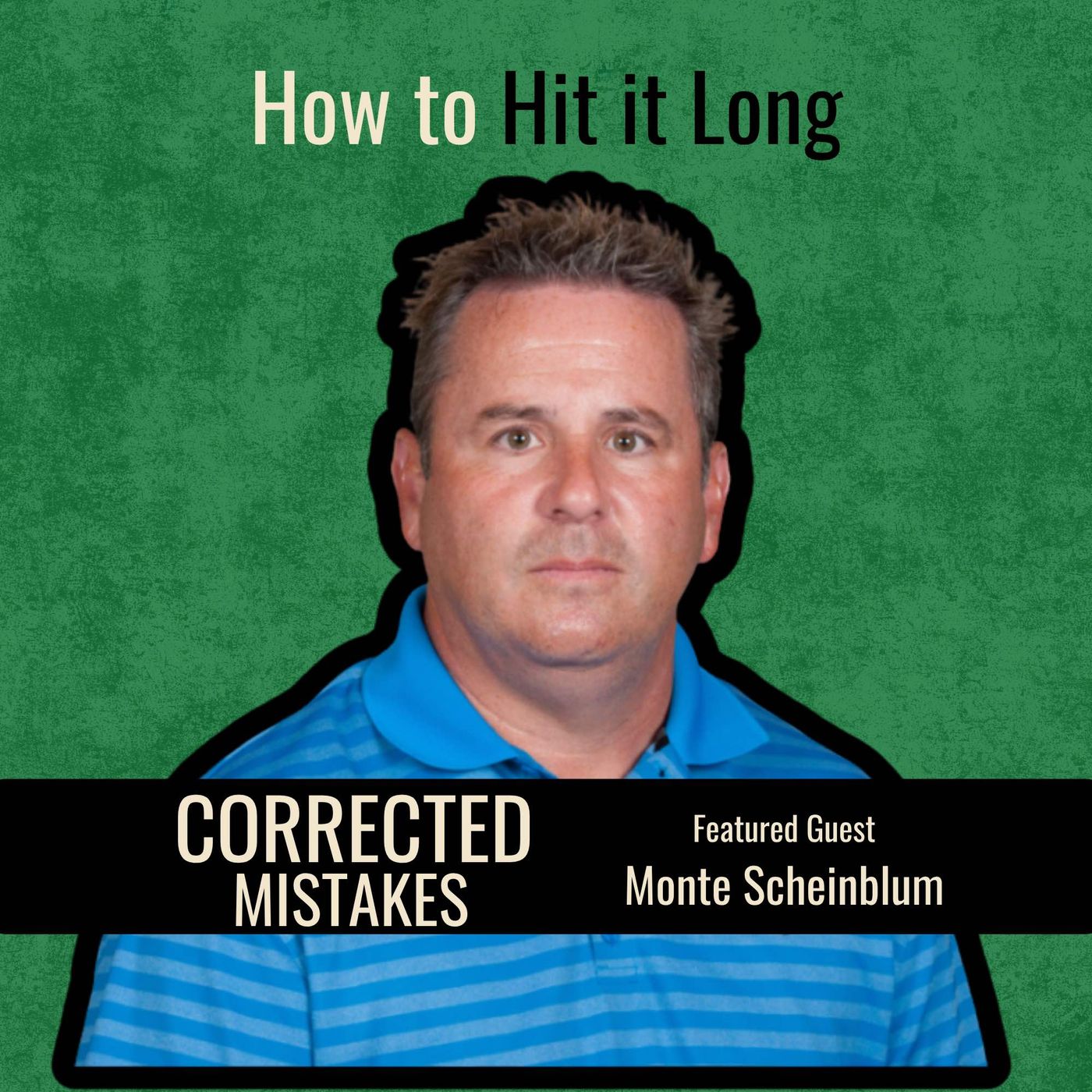
How To Hit It Long with Monte Scheinblum



 RSS Feed
 Monte Scheinblum is a former long drive world champion who has the keys for helping any golfer hit the ball further. Monte joins host Josh Karp to discuss his path from son of an MLB All Star, to the world’s longest hitter and his deep data-backed analysis for what it takes to hit the ball far.
If you want to hit it long check out Monte's Youtube channel: https://www.youtube.com/@MonteScheinblumRebellionGolf
For exclusive content and first access check out Corrected Mistakes on Substack: https://substack.com/@correctedmistake
0:00 As I've studied the golf seling in the last fifteen years, everything that has been said that creates clubhead speed is pretty much wrong. If you talk to the right people, the smart guys that actually study the data, they will absolutely agree with this. What has been taught for a century is at best misleading and at worst the opposite of what's supposed to happen. And the people that actually taken the time to study it are immensely successful at making people hit it farther and straighter. I'm talking to Machi schein Bloom, who is a long driving champion and golf instructor, and I want to first of all, thank you for being here today. And it's you know, everybody wants to hit the ball crazy far right, and now statistics are showing that that is a huge, uh huge factor.
1:01 And yet and yet you still hear the old school people argue drive for show and putt for dough and actually get angry if you say, well I don't know about that, you know. Right, Well, why don't we start there talk a little bit about, you know, the advantages of you know, why hitting it long is so important these days. I mean, obviously you see Bryce and Rory, can you know, just massacre the ball. Well, I mean, let's be honest, at every skill level, you're going to hit a wedge closer to the hole more often than you're gonna hit a seven or an eight iron. It's not more complicated than that. And with the advent of the new equipment, unless it's the US Open, you know, I mean, obviously you don't want to hit them all fifty yards offline into someone's yard. But but not just statistically, but empirically, hitting fairways is vastly overrated. Okay, so just you know, good, I mean missing the fairway by forty or fifty yards, yeah, no good. But you know, the number of golfers who are going to hit it closer from one seventy from the fairway versus one forty from the light rough is zero, you know.
2:34 H no, absolutely, So well let's start so, you know, just go back for a second. You know, So your dad was richiesh Eein bloom right, who was a professional professional baseball player. Yeah, I mean the league baseball player for about ten years. Is it all Star too, right? One? Y'ar? Yeah? In seventy two, was that the year of like. That famous All Star Game or was it could there There's like a really famous one of Tiger Stadium. I was seventy one they before that was the one where Reggie Jackson hit the home run out of the stadium and where Pete Rose and Ray Fossey had the Collie right. However, there was an excellent event at the seventy two All Star Game as well, the one my dad played it. And that's one of my memories as a child that being definitely afraid of when this happened.
3:27 So it was an old Atlanta Fulton County Stadium and Hank Aaron was at the end of his career and he had home run and the crowd went so crazy the stadium shook, and I was afraid. I was only five years old at the time. Wow, wow, God that Yeah. I mean I remember watching, you know, I think they all you know when he hit his you know, seven hundred and you know, fourteenth or whatever, and I remember the watching it on TV and you could kind of feel how intense that experience was for the people in the stadium. Yeah. So as a side note onto both of these things, I've played golf with Al Downing sometimes. Yeah. Really nice guy has a really good sense of humor, you know, unlike Eric Shao who was bitter about giving up Pete Rose's record breaking Yet you know, Al has a really good sense of humor about He's like, look, man, you know pictures give up home runs all the time. How many give up a home run? That's baseball history. He goes a lot more people know who Al Downing is because of that home run than had I just given up home run number seven twelve? Right, So he has a really really nice guy, has a really good attitude about it.
4:47 And then you know, nineteen seventy two, I was five, that's. You know where some of my first memories are coming from as a child, and I remember my dad giving me three baseballs and say, see those three guys over there, ask them if you can have your autographs? So I walk over and I go, uh, you know, can I have your autograph? And I had the three baseballs and they're like, you know, what is your dad playing it again? And yeah, asked my dad over there. And the three.
5:30 Guys were Hank Aaron, Willie Mays, and Carli Strat And my dad's hero growing up was Willie Yes. And I don't remember this part. It was relayed to me later on, but apparently Willie Mays told me that my dad was to go back and tell my dad that he was a great hitter, and you know, said some good things. So you can imagine me coming back and said, Dad that that guy said that you were a great you know, having your childhood hero telling your son that you're a great hitter. You know, it's like, you know, absolutely, you know. Yeah, So that was you know the number of things I got to experience because my dad got traded a lot, so I got to experience more things than you could possibly imagine. Like, you know, when I was the following year, he was with the Reds and he got traded into the Reds because he was making twelve thousand, the league minimum.
6:34 He made the All Star Team, almost beat out Carew for the batting title and beat out Reggie Jackson for the Sporting News All Star Team. Asked for a raise from twelve to twenty four thousand, and the Royal said, you know, forget that, and they traded him. You imagine, right, So now you know, it's the following year in May, a month into the season, and my dad brings me into the locker room. He says, yeah, it's my son's birthday. Joe Morgan called me over, gave me an autograph ball. Johnny Bench came over, gave me an autograph ball, and then Rose called me over to his locker and gave me his glove that he used the first month of the season. Right, So then it gets better. So he was only there for a couple of months. He didn't get along with Sparky Anderson very well, so then he got traded to the Angels a couple of months into the season. And at the end of that season, the seventy three season, that was the year that Nolan Ryan broke Sandy Kofax's single season strikeout record that still stands today.
7:44 And my dad was a fraternity brother in college with Ed Louder. Huh, if you don't recognize everybody has seen twenty movies with Ede. Yeah, he's in the what's it called, He's one of the guards and uh, yeah. No, he's Captain Knauer in the Long Yard. Yeah, but you know he's in every single movie, it seems like in the seventies and eighties. So Ed was asked by young Ron Howard. Who was just a teenager at the time. You know, you know, Richie, can you get me tickets to the game, because because Nolan Ryan's my hero? So I watched. I'm sitting in Annah, I'm stadium watching Nolan Ryan break Sandy Kofax's record with teenage Ron Howard sitting next and and you know, I could literally go on for hours on the Yeah, these stories.
8:45 So well, okay, so you were you were a baseball player, and then you had an entry, right. Yeah, and I was pretty good, you know, to this day. You know, I was the world long driving champion. I almost got my tour card a couple of times, had a couple the chances where I could have gotten my tour card, almost one on the Cornferry Tour. And I was a much better baseball player than golfer. But I you know, I injured my elbow and the doctor said it was pretty serious and I shouldn't throw anymore until I was full grown, which turned out to be about five or six years later. And I just got into golf before before that. Yeah.
9:26 So and then you plea you you were good enough. You played in college, right, played golf in college? Yes, So how quickly did you become because you know, what do you hurt your elbow and you're like fifteen or something like that. Yes, yes, so I was not very big. I was only about five six or five seven when I graduated in high school when I was eighteen, and then I grew like six inches in the next three or four months and couldn't hit a wedge on the green from eddy eighty yards and actually got short or off the tee because I was awkward right from growing so quickly. And then it took a couple of years for me to kind of, you know, grow into that height. And then all of a sudden, when I was about twenty one twenty two, I went from being you know, above average off the tea to being longer than everybody I knew, to being the longest in the world in like a two or three year stretch.
10:27 Now I explain how I mean. Was that just all physical acclamation in your body or was what were you doing that got you to hit the ball like that? Think nothing, I just I mean, this sounds ridiculous and it sounds cliche, but when I look back on it, it wasn't like, all right, I hit it two seventy, then I hit it too ninety, Then I hit it three ten and blah blah blah blah. You know, looking back on it, I'm sure it was a little more, a little more extensive than but it's like I went from hitting it two seventy to three point fifty in a week. I mean it was obviously longer. Yeah, time on that, but it literally happened, like you know, I mean, so like when I was twenty one years old, I was pretty long, longer than most of the people that I played in amateur tournaments with and college tournaments with, longer than most people. Then when I was twenty two and twenty three, I'm like, wow, you know, when I go to the charity baseball games, uh, golf tournaments, I hit it longer than all the baseball players. And then all of a sudden, when I was twenty four, it was like, I mean, I'm out driving everybody by fifty sixty.
11:47 Yards and it just it just happened. It was just yeah, I didn't I didn't do any training, any speed training, any weight work, and again I was I was pretty weak as a high schooler. It's I mean, it's not a joke to say I probably couldn't bench press one hundred pounds when I graduated from high school. And then when I was around twenty three or twenty four, you know. I could lift up the condo I lifted lived in and move it next door. So okay, So so you started doing long driving stuff when you were in your mid twenties, right.
12:28 Yeah, twenty three was when I started. Yeah, and what you know, what was it about? I mean, you know what you know obviously, you know you got big and he got strong, But you know, was there anything about the way you swung the club that you felt like was make no? Just pure pure power and speed. You know, there's a there's there's a line from the movie Days of Thunder where Tom Cruise plays a stock card yeah, and he goes, I don't know anything about cars, and he goes that that you know, Robert duval Assi, Well, how can that? He goes, I don't know. They put me in a car and said drive. Then I could drive, you know, and it was kind of like that, you know, you know, they said, yeah, swing hard, let's see how far you can hit it.
13:11 And I could hit it really far. Now, So okay, so you just said swing hard. I always am fascinated by the idea of is it swinging hard or is it swinging fast? And is there a difference? Well, okay, this is this is gonna sound like double talk. If you know how to swing fast, you can swing hard. If you don't know how to swing fast the right way, you can't swing hard. So trying, can you try to break that down a little bit, because I'd love to. Absolutely I just learned it naturally for by luck. I don't know what else to say. But as I've studied the golf swing in the last fifteen years, everything that has been said that creates clubheads is pretty much wrong.
14:01 Okay. And that's the thing. And if you talk to the right people, the Chris Comos, the Mike Granados, Sean Webb, Dana Dahlquist, the smart guys that actually study the data, they will absolutely agree with this. What has been taught for a century is at best misleading and at worse, the opposite of what's supposed to happen. And in the last ten or fifteen years, they've been able to objectively measure what happens in a good swing, what happens in a fast swing, and the people that actually take in the time to study it are immensely successful at making people hit it farther and straighter. But the problem is that's maybe ten percent or less of the instructors out there.
14:56 And that's the reason why when you watch it, like when you watch the tour of the seventies and eighties, the swings were vastly different, and no two swings are the same. All of the young guys coming out, ninety percent of them look like robots. They all look the same because the young guys coming out have gone to instructors that have the benefit of what actually is happening. And the old cliche is it doesn't matter how you swing. Impact is all that matters, because there are vastly different swings, but the impacts are all the same. The irony is, the more they study it, the more they find all good swings are doing three or four the same things and impact is vastly different.
15:47 So what are the three or four things that they're doing? So proper shifting of pressures in the feet which used to be load up the right side at the top and then push off the right side to get left, and they found that essentially nobody good does that. Guys are starting to move left as they reach the top of. The spring, their hips are turning while the club is still back. No no, no, no, no, no, no, not turning. Okay, Amateur golfers tend to turn their hips way too early. Okay, Yes, there's a split second where the hips turn before the chest in the arms, but the gap is only ten milliseconds.
16:35 Okay, it's about shit, It's not about rotation. As a matter of fact, I just put I put three videos up on Instagram within the last couple of weeks. It was Rory Rose and JJ Spahn, and I'm like, watch how and these are individually, but I said the same thing. I go watch how as they reach the top of the swing, they're starting to shift their weight into the left side, and they're not rushing their hips open. They're waiting for the backswing to complete and the pressure to get into the lead side, and waiting for their arms to sequence with their body before they turn. The rotational speed, which is another one of the things that creates speed proper sequencing of the body parts. So when the hips wrote accelerate and when the torso accelerates, that's only a ten millisecond difference. When the torso accelerates and when the arms accelerate, that's only a ten millisecond difference, So between when the hips start to rotate and the arms accelerate, it's twenty milliseconds. The blink of an eye is three hundred and thirty three milliseconds, so you can see. Okay.
17:55 The other thing that they've measured is elite golfers and long hitters accelerate their arms and hands and reach maximum acceleration very early in the down. Sol Okay. Amateurs do that very late in the downsall right, Okay, so the whole fire, the body and the arms and hands are behind and along for the ride that is produced. Literally, ninety to ninety five percent of amateur golfers accelerate their hips early and their arms late because they're actively doing something that only has the real small. Gap, right, I mean, is you know, in terms of how easy would it be for an amateur to do the things you're talking about, I mean, obviously you very very easy. Okay.
18:54 The only road there are two roadblocks to amateur golfers making their swings better. Number one is the narrative that they've been living by. Is objectively all this stuff. I'm telling you, these are not my opinions, these have been These are objective measurements that can be found by anybody, and. So, first of all, their narrative has been incorrect. So the lead with the lower body thing, there's two facts about a couple of facts about this that are important. Number one, it is physically impossible to not lead with the lower body when you start the downswing if there's gravity and your feet are connected to the ground. Okay, it takes. And then fact number two is it takes the human brain two hundred and fifty milliseconds to actively do something. So the gap between the hips and the arms is twenty milliseconds, the brain takes two hundred and fifty milliseconds. So if you're actively trying to lead the hips away from the arms, you're doing something redundant that's increasing the gap, and that throws off clubhead speed because if the arms don't excel and hands don't accelerate early in the bat in the down swing, they can't decelerate late in the down swing, and deceleration of the arms
20:25 and hands is what accelerates the club. Explain how that works. I'm trying. I'm just for me because I'm trying trying to understand how Because deceleration right I mean just in general. You know, you're always been taught right that you don't want to decelerate, and ear least I've always everybody's like, oh, you're decelerating, you're decelerating, you know. Right, And and I'm sorry, And you know what, I just had this conversation with a student this morning. I never want to sound like I know everything. Everybody knows nothing every day. But I mean, that's why you're here, you know, you know. Okay, but it this is that this is and again an objective fact, not even with golf, it's it's physics.
21:12 When there's rotation of multiple segments, what causes acceleration is deceleration of the previous segment. Okay, So the hips decelerate, that accelerates the torso, the torriso decelerates, that accelerates the lead arm. The lead arm decelerates, that accelerates the club. Okay, I get it. Yeah, Okay, that proper sequencing is what creates maximum club. That's feed. So going back to the previous thing. I know this is super technical, but if your arms and hands accelerate late early, they can decelerate late and accelerate the club. If they accelerate late, then they have to speed up at the bottom to get the club to the ball, and you're not getting the benefit of the of the deceleration. And again, the reason why I know this is because when I post some of these objective measured facts on social media, everybody calls me an idiot, and I'm like, well, you're probably right. My ex wife agrees.
22:32 But all of this stuff I've said in the last five minutes, these are not my theories, my opinions, whatever, whatever. These are things that multiple you know, biomechanics specialists, scientists, guys with three D systems. It all says the same thing. You know, right, well, and there's a benefit of all this data now too, right, I mean that's right. Right, And mean, like I said, there's a I mean, yeah, people get bigger and stronger, there's evolution, training is better, people in better shape, blah blah blah blah. But this is why you're seeing all of these like not physically like I wasn't physically imposing when I won the World Long Drive. I was six to one hundred and eighty pounds, you know, and you see all these guys coming out of college, they're five to nine, one hundred and fifty pounds and they're swinging one hundred and twenty miles an hour because they've had the benefit of all of this data.
23:33 That and the data is not for the golfer. The data is for the instructor. So then the instructor can just look at the golfer and say, Okay, do this one thing differently and you'll hit it far right right. You know, I would never give a lesson and spout all of this nonsense unless happens all the time. My client's an engineer and wants to know, well, Monty, is this your opinion or is this like factual? So then I you know, have to bring the data out to prove it. But during a lesson, you know, for me, you'll get you know what, your setups a little off here, and you know you kind of need to have the Jack Nicholas feel here of keeping your back to the target a little bit longer because you're opening up a little bit too quickly. That's about as complicated is my lessons?
24:27 Get Okay, Yeah. Well, so now I talk about yeah, I mean because I I know I heard you talk about this on on you know, another interview. Being able to obtain accuracy with distance. You know, you were saying, how that those are not so mutually exclusive as people think. No, And that was the point that I didn't make before because I go off on tangents because I'm a nerd and I but swinging correctly is physically easier to do than the stupidity that most end up doing. That's why you see guys like Ernie El's and Fred Couples and Jake Knapp look so effortless and they hit the ball so far. You're not seeing smooth You're seeing efficiency, okay, And and that that's what this is all about, is these movements are actually easier to do movements that the proper Like you can increase clubhead speed.
25:30 The wrong way and then you're gonna hit it all over creation and. Hurt your back. But but if you do things the right way to increase your clubheed speed, not only do you put less pressure on your body, you get a more consistent path and face angle on the club face. So how okay? So yeah, it's funny. I mean I took a less from a guy who teaches basically Mike Austin, the Mike Austin swing, you know, the guy who hit the ball five hundred and fifteen yards and I actually found and I had it going for about a month and that I lost it. But it was interesting because you know, I was like really hung up on you know, like my previous swing was very much, you know, focused on controlling the you know, the illusion that I could control the ballflight right. And the guy who was taking the lessons from me said, you know, you'll hit it straighter, and I thought, oh, you know, bullshit. You know, like this feels so out of control to get the club back this far and to move this way. And I was so worried about the club out getting through it.
26:43 And once I turned that off, I was hitting the ball so much. I was hitting it about thirty yards further and way straighter. So yeah, and I can't do it anymore. But you know, well, okay, let's let's let's you know, let's be transparent and honest. There is not one field that has kept its narrative the same in the last fifty years that are science based, okay, So like teaching a pure Mike Austen system, or teaching the golf machine, or any of those things that were invented fifty sixty years ago. Okay, those were innovative fifty or sixty years ago, but those ideas are antiquated now.
27:32 Right right. But I mean, it doesn't mean you should. It doesn't mean it's not educational to learn about those things. And there aren't some nuggets in those things, you know, like there's some good stuff from the golf. But you know, the joke I always make is is I go You know, you don't go to the doctor and let him feel your knee and put a leech on it to make it better. You know, you have an X ray and an. MRI and and and and you know a new a new panel of a range of motion tests that are you know, recent discovers. It's the same way with the golf swing, because you know, uh I did. Chris Como asked me to speak at his national symposium, the Open Forum, two years ago at the Golf Show, and they wanted me to get up there and basically say everything that's ever been said about the golf swing is wrong, you know, because they know I'm not afraid to say anything and hear the backlash and every single tried and true cliche that has been said about the golf swing in the last ten years has either been proven to be at best misleading and at worst the opposite of what good players did.
29:02 Okay, so just you know, for give me, like you know, two examples of things that we've been told all these years that. Are now the the three that I disproved, I go, I had forty up on my display. One of them was dry for show, putt for doe, very misleading. Okay, you gotta make putts to win, but but you gotta get there, okay, right, So the three that I disproved were slow, smooth tempo, lean with the lower body, and hold the leg. Okay, and all three of those, there's still seventy eighty ninety percent of the golfing public trying to put those three ideas into play on a regular basis.
29:48 And all three of them are just plain horrible. So what so what do you replace that with? You know, what's what's the what? What would what would you say? You know is the so, so I'll go through all three of them. Slow smooth tempo is awful for your golf, soel, because if you go back slow, your two choices are come down slow or rush the transition. Any musician will will agree with what I say here you don't want slow smooth tempo. You want slow smooth rhythm. Right, talking about rhythm real quick?
30:31 Just okay. So, so like Stairway to Heaven is a slow tempoed song early and a fast tempoed song later. Okay, the the rate at which they play the notes speeds up, but the rhythm of. The music is spot on the whole way through. So so if you if you have a slow backswing, which almost every amateur does, it's almost impossible to have a smooth rhythm and hit the ball anywhere. So you're actually and people say, ooh, I got quick in transition, I need to slow my tempo down. You just made it worse. Okay, lead with the lower body. We already kind of touched on that sum. The lower body leads automatically, and if you are actively trying to have the arms and hands trail the lower body, you are making you you are creating a gap that you can't recover from casting, flipping over the top, all that good stuff. So the problem whenever I hear someone say, you know, I have an arm driven swing. I lead the downswing with my arms, I'm like, what you just said is impossible to do.
31:59 It's a misinterpretation of feel. So what happens is and this is where they get the feel from. They get up there, they fire the hips really hard, the arms trail behind, they run out of range of motion, their lower body stalls, and their arms take up and accelerate at the bottom. And everyone goes, oh, that was all arms at the bottom. Yeah, it feels like all arms. Yeah, you got to get that lower body to start the downswing, and you just made it worse, right. And so these are the kinds of things that I proved to people every day. I just had a guy just a couple of weeks ago. He goes, Monte, I'm working on slowing down my tempo and he makes a swing and I go, yeah, that's your problem. He goes, yeah, I knew it was. Yeah, I tempo is way too slow, way too slow. And he goes, what are you talking about. He goes, I need to slow it down. I said, okay, bear with me.
32:56 I took a video of his swing and they put it next to Ernie El's be easy, mister smooth tempo. And Ernie Els was literally in his finish when this client was at left arm parallel in the backswee okay, and so he would everything would like durt in transition, trying to create some speed with his uber slow backswing. So I said, you know what, And he was swinging a seven iron in the fifties miles an hour, and I said, you know what, just humor me. Take it back as fast as you can and swing your arms down as fast as you can. In one swing, he went from like fifty six to seventy five and he was still he still got to the finish later than Elsby.
33:51 So these are the kinds of things, and you know, yeah, it's it's people believe. You know, I'm not athletic enough, I'm not in good enough shade, I'm not flexible enough. My core is not strong enough. I don't practice enough. You know, I'm this, I'm that, I'm terrible, I'm a loser, blah blah blah. And I'm like, well, those are the reasons you're not a PGA Tour player, right, The reason why you're not a better golfer is you're trying to do the wrong things. You're prioritizing the wrong things. So it talked a.
34:32 Little bit because I mean you you you went on a search right for yeah, talk about tell that I would like to hear about the search and the resolution. Okay, So to get back to you know, I was the longest hitter in the world in the early nineties, early in mid nineties, no debate. I had the lead in corn Ferry Tour events the back ninth Sunday if you times, Okay, a couple of times. I was at second stage at Q school and I was one swing away from making my move, okay. So I was a great player, just not quite PG tour level. So I started taking lessons from a lot of the big names at the time, and I got worse and worse and worse and worse and worse and worse. So like nineteen ninety four was probably the year that I was the best I was. And if you ask me to swing a driver one hundred and fifty miles an hour, I could.
35:44 I was probably one hundred and thirty five. You know, with modern technology, i'd be in mid one nineties, maybe even a few two hundreds ball speed during a round of golf, and you know, my handicap was probably plus six or plus seven and whatever that matter, way into the pluses. Fast forward to two thousand and eight, when I was forty years old. My clubhead speed was down, and I was probably physically stronger at age forty, and I was in good shape still. I was probably one hundred and ninety pounds, maybe two hundred pounds, and my clubhead speed was all the way down to one hundred and ten miles an hour, and I was a five handicap who could shoot sixty five once in a while.
36:34 I was awful. I was awful. So I lost forty miles an hour, thirty miles an hour club at speed, and I couldn't work regularly anymore. So I quit. I quit golf, not pro golf. I quit golf, and I didn't know what I wanted to go into because being a pro golfer is all I knew. So while I was figuring out what I wanted to do next, I spent the entire higher year two thousand and eight watching golf swings on the internet, okay from like I would go into YouTube and say, this is the worst golf swing ever, and then those would come up, and then I'd be like, you know, scratch golfer swing, and those would come up, and then I'd study. I'd pick videos of this because my DVR at the time, I could do frame by frame of a So I film all the PGA tour events and study everybody's swing on the tour.
37:33 So then I said, I started to notice patterns, and I said, Okay, all of the prevalent ideas are not really matching what I'm saying here. All the quote unquote fixes. You know, people that are over the top dropping in the slot and swinging the right field, people that are casting hold the lag, people that are stalling an impact, get those hips more open. And I'm watching and I'm not seeing any of this stuff. So I did something that I'm guessing nobody else has ever done before or since.
38:14 When I was a long drive champion, I was also a trick shot artist, and I became really good at copying people's golf swings. So I spend all of two thousand and nine, I probably three hundred and sixty five days. I probably went to the driving range three hundred and twenty days that year. And all I did was I would go to the range. I'd look up and down the range, and I'd find the guy that was the most frustrated, and I'd go over there and live, you know, gorilla style. I'd video his swing, and then I'd go back over to my stall and it take me about five minutes. I'd start copying his swing and his ballfly okay, and then I'd spend the next four or five hours trying to fix it. And I did that essentially every day for a year, and I started to find out that the common fixes for common swing faults were often the opposite of what you should be doing. And I started to also figure out the common swing faults were not false at all, but necessary compensations to get the club to the ball when you were out a position.
39:25 Okay, so. Early extension is like the dirty word right now. If you snapped your fingers and eliminated someone's early extension, they'd hit it worse because they're early extending, because their club face is too open, the pitch of the shaft is too steep, they had poor pelvis rotation in the backswing, they're standing too close to the ball. So if you keep all of those things I just mentioned and just keep your butt back on the wall, you're going to hit the ball significant le worse. Whereas if you solve that problem, your starting body starts to react and starts to rotate instead, of thrusting right.
40:10 Right, So how did you sort your swing out from fixing the other swings? The yeah? So then I said, okay, And then here's what was really funny is starting in around two and ten twenty and eleven, I started posting my crazy ideas on YouTube and it was the reaction was seventy five percent. Wow, this is interesting. I've never heard this before. I went and tried this. It actually is helpful. You might think about teaching golf. And then twenty five percent is you're a moron, you're an idiot. Nobody good does what you're saying.
40:55 Well, that's pretty good. That's a pretty good percent. I've just given this the internet because everybody thinks that half of the world thinks everybody's an ideot on the internet. So fair enough, fair enough. But most of the people were willing to listen and give some credence to what I was saying because I was fact a near tour level player and a world long driving champion. Okay, so they're like, well, this guy wouldn't be where he wouldn't have accomplished what he accomplished at these eyes, which is these diadems, which is completely ridiculous. So if you fast forward from like twenty ten twenty and thirteen, I went back and started competing and long driving again. I was forty six years old and I was getting up to one forty again. And I finished sixth in the World Long Driving Championship in twenty thirteen when I was forty six, and then in twenty sixteen, I made it to the Fine the champions Tour Q School and then you know, disaster struck. I blew my knee out the week before I left for finals, and I didn't play very well.
42:10 And you know, and I've qualified for a few US Senior Opens and stuff. So I hit a valley in my clubhead speed in my game. And now I'm fifty eight years old, I've gained a ton of weight. I'm like fifty pounds overweight. I play golf once a month maybe, and I still break part pretty much every time I play. And I can still swing one hundred and twenty miles an hour when I. Fill the need to. And it's because even at my advanced age and my really poor conditioning, because I understand what's actually supposed to happen, it allows me to still hit the ball pretty far and play some good golf despite my age and physical limitations.
43:06 For the average golfer, So you know somebody who's a fourteen handicap, right, which is probably not average. I'm sure that's that's about above average. Ouah, right, So what's what's average? Twenty? Yeah? I mean they say that, you know, if you break a hundred year above average. Okay, So for for the average, you know, the average player, what what are the you know, two or three things you know? I mean, obviously you're not seeing these people's swings and you're not, you know, less of sure, what are the things both you know to improve you know, to improve their swing and also to hit the ball further? Absolutely? Okay. So and this is going to sound really snide and it's not meant to be, but you have to stop listening to what you think and what your friends say. Okay. The running joke I have is I've never been even charged with a misdemeanor. And I've seen all thirty seasons, every episode of Law and Order, and if you got arrested, you wouldn't want my legal So so honestly, you know, I know I come off really poorly when I say things like this, but I want I'm very passionate about golfer having more fun and getting better.
44:27 But in the last fifteen years, well, let me back up. In two thousand and eight, I was the longest hitter in the world, and I had nearly made the tour, and I wasn't qualified to teach someone grip. Okay, So the average eight handicap giving advice to his brother in law who's a fifteen. I'm sorry, guys, it's a disaster. Don't be mad at me. That's a disaster, okay, because the root causes they're not being addressed. And when I go to golf courses, I just hear and I'm like, and I'm not one of the guys that want it starts giving unsolicited advice. I just kind of go like this and go, well, they're having fun, so who cares.
45:15 So Number one, these are the three most common mistakes that golfers of all skill levels make, even even two handicaps. Number one, they get the grip too much in the palm of their hand and not enough at the end of their. Fingers okay at the end, yeah, okay, okay. Number two, and this is the one that I get the most heat on social media, is they move the wrong hip when they rotate, So you can draw a line in the sand and you're going to be right more than ninety five percent of the time. If people move the right hip, they'll probably scratch you better. If people move the wrong hip, they're worse than scratch. And what it is is elite golfers rotate. So I'm a right handed golfer. Here, they rotate by bringing the right hip back and behind them. Then they shift and they bring, then they bring the left hip around and behind them, and that pushes the right hip forward. Okay, that's what you see in every the AMG guys put up. If you do a Google search, a YouTube search for athletic Motion golf how to clear the hips. It's a Joe's versus pros. It's pink on one side, blue on the other side, and the angle of the gears read out
46:49 is from above looking straight down on the golfer. Pretty much. They made it like six or seven years ago, and pretty much. I still think it's the greatest technical video ever made on the swing in my opinion. And and so so here here's the right hip, here's the left hip. So good players rotate, they have a little shift to the right and then the rotate right hip works behind. Then there's a little shift back to the left. Then the left hip works behind and that pushes the right hip forward. Okay, what the average golfer does is literally the exact opposite. They they bring the left hip out to rotate, then they bring the right hip out to rotate. Well, that's both of those are going to bring the center of your pelvis toward the ball. You won't rotate, you won't shift correctly. You're going to cut off everything, and you're basically gonna have to stand up, stall and throw your arms in the hands at it.
47:53 Right, Okay, And how do I do I? How does somebody learn? I mean, obviously you're describing what to do. How do you learn to do that? Because I'm thinking about it right now, and I'm thinking. It is literally as simple as I said it. When you just stand up, just stand up straight and move your right pocket behind you, Okay, then move your left pocket behind you. It's it's actually easier to do than doing it the wrong way, right, No, it it? I mean it makes total sense physically, but mentally, I mean I think that's you know, the biggest thing, right is how do you get yourself thinking about.
48:36 That's and you know what people say, well, these things should you know, risk movements and this this should happen naturally. Well, yeah, if you're doing it right already, they happen naturally. If you're doing it wrong. You know, like a pitcher in baseball is release points starts getting too low. The pitching coach says, got to get the release point up here. Well, what's more natural than throwing a ball. But you got to work on your plant foot in the right place and your release point right. And literally it is as simple as just stand straight up and down and move your right hip to rotate. That's the right way. But just so you know what you're doing, move the left hip out you'll fall down. Okay. So it's nothing more complicated than changing a bad habit, okay, because it's easier to do it the right way right.
49:32 And then the third one, this might be the biggest one, even more important, Like I've seen people with crappy grips and bad hip rotation in the backswing still make a good golf swing by doing number three correctly. And this is one that's super, super subtle. And again, the number of people that do this right is such a small number. The shift to the lead side is the last move of the backswing, not the first move of the downswing. Okay, almost everybody does this wrong. I did it wrong, okay, and it was one of the reasons why it was so inconsistent.
50:17 It's okay, So taga, how do how do? How does somebody work on that? How does somebody just going again? You know? You know, I have something called the Nike drill. Just do it. There are drills that are helpful, but it's just it's it's just being like on a teeter totter, So you teeter to the right and you totter back to the left as you reach the top. Right really is simple. So when it's measured, elite golfers reach their maximum right side pressure, like their shift to the right, very early in the backs room. Dis Chambeau and Scheffler are right around cheft parallel. Most great players are around left on parallel, whereas the average golfer reaches maximum right side pressure at the top of the swede. And that's why you see a lot of hips way, a lot of upper bodies way. Whereas so whereas you'll see elite golfers they'll shift to the right as they take it away, they'll go right and then write them out here.
51:19 You'll see them do this, and you see them settle down into the left side as they reach the top. For anybody listening. Go to it's much easier to see it than it is for me to describe it. So just like three four days ago, I got a great picture of Rory at the Ryder Cup. I was at the Ryder Cup. Got a great video and it's from behind, so we're looking at his rear end. The women all like that, and you can see clear as day. So I draw a lot line on the seam on his trousers. So here's the seam of his trousers and you'll see clear as day, there's a little movement to the right and then a rotation and back to the left, and as clear as day. And it's only awkward because you've never done it before. It's literally the same thing as because and I'm experienced with this, because I got a sixteen year old and a fifteen year old. It's literally like putting someone in a car for the first time. All of us that have been driving for years and decades, we could almost drive blindfolded. Okay, but when we first got in the car, it was scary and awkward, and you gave too much gas and you hit the brake too hard and you turn the steering wheel too much,
52:52 and it was all a mess. Okay, these three the grip is the grip. These other two moves are the same exact thing. It's super easy to do once you'll learn how to do it, but learning how to do it is very awkward and difficult, and we run into the biggest hurdle. The golfer is getting better. It's not lack of fitness, lack of talent, lack of iye and coordination, or even lack of practice. The biggest hurdle is this feels weird. Right, and how do you? How do you? And that's just a practice thing, right. If you know, If if you are sitting watching this and you can't get past this feels weird, never mess with your golf swing again. Just go there, have a good time. You're a solid golfer already. Don't try and fix anything, because if it feels good, you're not doing it right. You're just doing what you normally right. If it doesn't feel weird or strange, or awkward. You're not doing something different, and don't listen to me. Tiger put the the best bit of golf instruction ever in history was Tiger put up six simple phrases on social media
54:24 about two years of huh, and this is the six steps to making your golf swing better. Step one, figure out the problem. And you really need to go to someone who knows what they're talking about to figure out your actual problem, not the you know the effect. Okay. Step number two, make it look better, just moving away that it looks better. You look like a better golf right. Step three, then it feels better. That's a long step right. Then step four they you start hitting it better. Step five, you hit it better on the golf course. Step six, you hit.
55:05 It better during a tournament or you know, your. Golf trip or whatever. And you're if you're and I say this sincerely, if you're not willing to be patient with yourself as you're going through all six of those steps, forget about improving. Just have a good time and go play right. Well, I mean, because I mean that's you know, I mean what you know. I haven't learned a lot, but one thing I've learned is when you decide to make a change, don't take it out on the course, right and you know, just go play. But when you practice, do it on the range, but don't start trying to you know, do everything different on the court. And people hate that because they're like, Monty, if I don't take it to the course, aren't I going to revert back to the bad habit. I'm like, yeah, but you'll only revert back ninety five ninety five percent of the time, ninety five percent of the way. Then there will be eighty seven percent of the way, there'll be eighty and and after an amount of time and you'll improve.
56:12 You'll you'll have incremental improvement. After amount of time, your golf course swing will look like your ringing, right. Yeah, no, absolutely, And I think you know like it because I mean I see so many people, you know, you're they're so miserable out on the course because oh I just changed my swing, you know, and they're and they're trying to do and they're trying, and that it gets you so in your head. So let's talk about that. That's actually extremely important. So you know this, this this should be taken at face value because what I'm about to say discounts my value as an instruction when you're trying to improve your swing, and when you're trying to improve your game, the mechanical change is actually down the list of importance. Okay, so like people will do this and everybody does this. When I say everybody, everybody does this, whether it's on the range of the course. Oh I pushed that one to the right. I need to roll my wrists a little bit to close the club face. Oh I hit that one a little fat. I need to like shift my weight harder. Oh I hit that one thin. I need to stay down longer. Oh I hooked that one. I need to hold the face open longer. That is insane for a number of reasons. Reason number one, who's going
57:42 to be successful making forty five different swings during a ring session or a round of golf? Okay, but even more insane, what are the odds that all three of these things are true? Ay, that you were a fud enough to diagnose from one bad golf shot, what the exact root cause problem was? You come out with the absolute correct solution for that root cause, And can you put that completely different narrative into play on the very next swing. The answer is zero, you know, so you got to get the work done on the range. And you know, I once had a client who I was trying to get him just do one small thing differently to hit the ball better. There's this first lesson and he goes, Man, Monte, this is just so much to think about it. I go, I asked you to do one thing different. He goes, yeah, but on top of my twelve step swing checklist. This is a lot to think about. And that's the reaction I had. I laughed and he goes, why are you laughing? And I go, that's pretty funny. He goes, why is that funny? And he goes into his bag. It was laminated and it was his twelve swing thoughts that he had on every shot.
59:13 Wow. And here was the sad part. All twelve of them were horrended. All none of those twelve were going to help him with what his issue was. So I know that's an extreme and that's ridiculous, but but people do that completely, you know, And and honestly it's I have people do a demonstration where I say, okay, count backwards from one hundred, one hundred, ninety nine, ninety eight, ninety seven, ninety six ninety five. Okay, good, Now take two golf balls and toss them back and forth between your hands.
59:55 No problem, I say, now do them both at the same time. They drop the balls and they stuttered the counting back right. So that's just two swing things, right. Imagine what three or four are doing to you. No, it's it's fine. I mean, I you know, and I actually I'm going to ask you for some personal advice here. So I played yesterday, and I'm about eighty percent of the time. I'm really consistent off the tea and that and and the rest of my game is not as good as my game off the tea. Yesterday, I could hit everything except for a drive. I could not hit a straight drive or a drive anywhere near you know where I I mean, I hit a couple in the fairway, but I didn't hit him. Well, so what's the difference, you know, between a driver swinging a driver, you know, because it was really disconnected. I hit everything great, except for the driver. I couldn't hit the driver. What is that a psychological thing?
1:00:52 Or is that No? No, it's it's it's it's actually very simple and it's going to make sense to everybody. What ever, your root cause problem is whatever it may be. Different sections of the bag are easier to manage, right. Obviously, the shorter of the club the easier. Well, not necessarily, not necessarily so, Like let's say you're really vertical with the shaft and transition right, most of the people that do that pretty good with the wedges, not too bad with seven iron. Once they get to about five iron through driver, they can't do anything right then staying on the right side too long. Those people are going to be okay with the driver, not too bad with the three wooden hybrids, and they'll be miserable with wedges. Right, So your individual setup issue, major primary sling fault is always going to be more manageable with a section of the bag.
1:02:01 Got it, Okay? I can. Oh, so it doesn't matter at all because I get people all the time coming mantie. I'm really good with the wedges, but I need a driver lesson. I said, Now, you don't need a driver lesson. I go, it's there on the wedge too, But I'm good with the wedges. I'm like, not as good as you should be. Your sight and so we solve the issue on the wedge or the eight and nine iron, I said, Okay, pull out driver, do the same thing, little five yard draw right down the middle. Yeah, I know. I mean I've tried. It's funny. I mean I've tried where I'm like, you know, oh, I just hit it like I hit my eight iron. Well, you know, in theory, that's what you should, right.
1:02:42 But the problem is is whatever made your fault, your primary swing fault, just makes it harder to hit the eight or harder to hit the driver, depending on what it is. Last question, what is your favorite if anybody pre modern sweat? So of the people who played on the tour in the seventies or the sixties or the fifties, you know, who's swing do you really admire most? Well, this is I'll give you a more specific answer, but the cop out answer is all of. Them, okay. And the reason why is is despite not quite doing this or that right, they matched it up correctly. Okay.
1:03:27 But if you pin me down and you're like, okay, who's swing you like the most? I probably say snead. Okay, don't get me wrong. I mean Jack Nicholas's swing people all flying right elbow and he does this and that an amazing golf swing where he matched the parts perfect right. You know, you know people would always like people will always like troll me and say, Monty, you know you're saying people should do this, this and this. So you would have changed Jim Furick, Jack Nicholas and Hubert Green. I'm like, absolutely not. But but but I'm like, no, no, But.
1:04:09 They don't have a problem. If those three guys came to me, well, I would have the same discussion with them that I have with the average golfer. I just don't say, oh, you do this and this wrong. Let's fix it. I say to each golfer, and I would say this to Furick or Nicholas or Green. Okay, when you hit a bad shot, what's its doing? Oh? Well, you know I tend to hit it in Matteau and you know it's a weak hit and it overdraws a lot. So then I put their swing up on the thing and I say, see this right here, this is why you're hitting it in matew So, like if Urick came to me and he's like, you know what, Monty, I'm a real consistent driver of the ball, great wedge player, but when I'm playing bad, everything kind of bleeds off. To the right, and I'd say, okay, Jim, you are much earlier with your hips compared to your right elbow then everybody else on the tour. And when you've got that light to the right, that disparity just gets a little bit too much for you to overcome.
1:05:19 So just be careful that your hips are not leading your right elbow too much. So that's what every lesson should be about, not what's going to make you look pretty, but why you mishitting them all? You know, And it's and where well, you know, I hit a big slice because I come over the top of it, and I'm like, right, but you have to come over the top of it. What do you mean, Well, you sway into the right side because you don't rotate your hips properly. If you didn't come over the top of it, you'd hit eight inches behind the ball on every shot you come over the top of it to get the club foote right.
1:06:03 So if they dropped it in the slot and swung the right field, they'd hit the ball eighteen inches fat every time in quick. Right right right, Absolutely well, Cole Manty, thank you for doing this, and tell everybody you know just quickly you know where they can find you, you know, on your website and and and on your social media and everything. Yeah, my website is Rebellion goolf dot com and you know the shameless plug. I have a new video coming out and it's a it's a how to manage your club face control while increasing your clubhead speed and you know, because those speed sticks they're great, but they don't help you manage the club right. That's going to be on Rebellion golf dot com. And then my Instagram channel, which I pretty much the only time I don't post every day is when I put something up there that's so popular that I want to let it run its course.
1:06:59 And that's at Monty Shine Bloom and all the golfers that want to get better fery Fleet. If you think everything I said is full of crap and you don't want to buy my video and you think everything I said was nonsense, please go to my Instagram channel and look at the video from three or four days ago of how Rory moves his pelvis looking at his rear rate. You watch that video, understand that concept. You will get better at golf and hit it farther. Awesome. Thank you for taking the time to do this, Monty really appreciate it. Thank you very much.