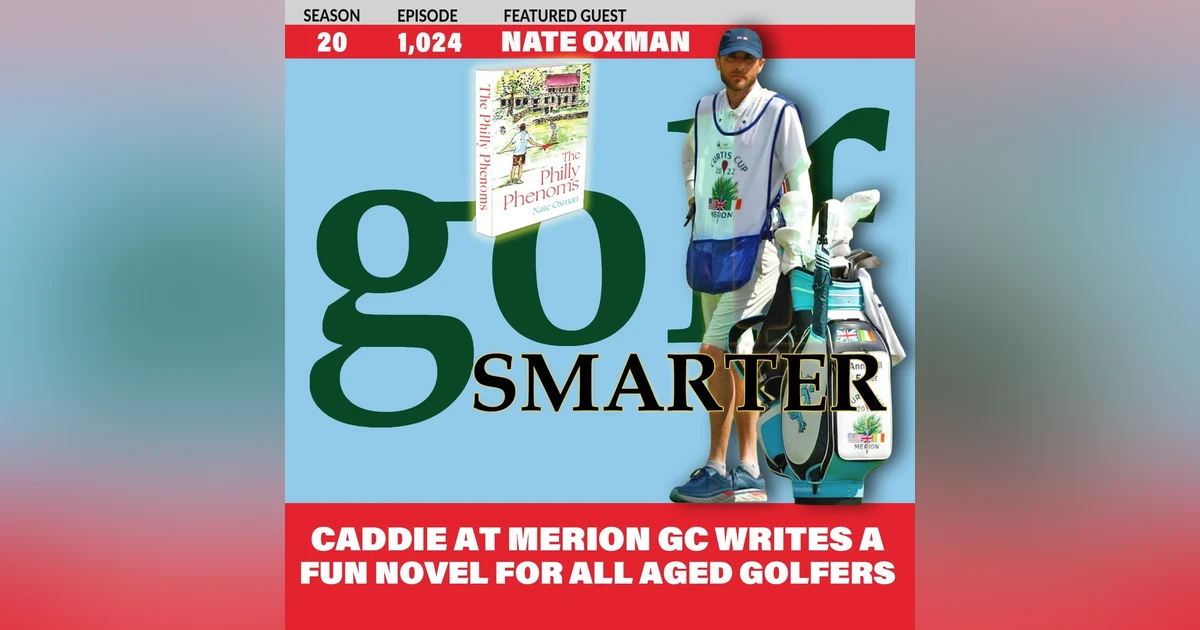
Caddie at Merion Golf Club Writes “The Phillie Phenoms” A Fun Novel for All Ages with author Nate Oxman


 RSS Feed
GS#1024 This week Nate Oxman shares his unique experiences caddying on the LPGA Tour, and looping for celebrities like Troy Aikman and Darius Rucker at Merion Golf Club in Philadelphia. He recounts a memorable encounter with Rucker, where he was offered tickets to a show and a humorous deal regarding naming his unborn child. In addition to discussing his first book “Phillie Phenoms”, a great golf story directed at teens, but good for any age, our discussion highlights the personal connections and stories that arise from such unique experiences.
This episode is brought to you by Warby Parker with over 300+ locations to help you find your next pair of glasses. You can also head over to warbypaker.com/golfsmarter right now to try on any pair virtually!
This episode is sponsored by Indeed. Please visit indeed.com/GOLFSMARTER and get a $75 SPONSORED JOB CREDIT. Terms and conditions apply.
This episode is sponsored by HIMS. Start your free online visit today HIMS.com/golfsmarter and received personalized ED treatment options.
This episode is brought to you by Policygenius. Secure your family’s future at Policygenius.com to compare free life insurance quotes from top companies and see how much you could save.
If you have a question about whether or not Fred is using any of the methods, equipment or apps we’ve discussed, or if you’d like to share a comment about what you’ve heard in this or any other episode, please write because Fred will get back to you. Either write to golfsmarterpodcast@gmail.com or click on the Hey Fred button, at golfsmarter.com
0:03 What up few sticks. My name is Brodi McPherson. I'm from Nova Scotia, Canada and I play out a Kabact Brett. Welcome to Golf Smarter Boys. Hi, I'm Thad Thomas from Cottage Grove, Minnesota and I play at River Oaks Golf Course. Welcome to Golf Smarter. Episode one twenty four. When I was writing, the publisher that I worked for owned a little golf magazine in Philadelphia, and I was the staff writer for that magazine and I interviewed Barbara Tello once. It was really cool. It was me another writer in him for like an hour, just firing questions at him. He said, if you went to the range at a tour event and you took away the name plates, so you didn't know who anybody was, and you just went up and down and watched each person swing the golf club, except for like Jim Furick or Tiger or somebody like that, you knew what their swing was like.
0:52 You wouldn't know if they were the fifth best player in the world or the five hundred and fifth best player in the world because they hit the ball so well and so something had to separate them. And it's the mental game. Can you do it when it matters most? Can you manage your waywhere on the golf course? Can you swallow your pride a play for four rather than going for a pin tuck behind a bunker or over the water hazard. So he'd said, you can't recognize the fifth best player from the five hundred and fifth best player in the world. So something has to separate them, and that's what it is. But mental game for sure. Oh Caddie at Marion Golf Club wrote a fun golf novel for all ages called The Philly Phenom by Nate Osman.
1:33 This is Golf Smarter, sharing stories, tips and insights from great golf minds to help you lower your score and raise your golf IQ. Here's your host, Fred Green. Welcome to the Golf Smarter podcast. Nate. Thanks Fred, appreciate you having me here. Well, I'll be completely honest with you. When your publicity people reached out to me about your book, I'm like, really, I don't know about this book. It's like they said, just can you just read it and let us know. I couldn't put it down. Oh, thanks so much. Well, let's just say this I read when I go to sleep. So I fall asleep reading. So I put it down all the time. But I couldn't let me say it this way. I couldn't put it down till I finished. I had to get to the ending of this story to see how it turned out.
2:25 That's awesome, that's what I want to hear. Yeah, I really enjoyed it. I had a lot of fun with this book. Thanks. That's the whole goal. You know, it's geared towards you know, younger kids, you know, ten to fifteen, but I was really hoping that adults would enjoy you two and would help spread the word for me, you know, for their children or their grandchildren or kids at their country club or whatever. So thanks so much for your kind words. And I'm glad to see that I'm doing something right. Well, I am a ten to fifteen year old, so it falls right in line. At least I act like it most of the time. But it's a unique story. And we'll get into the story because there's a lot of things in it that were golf lessons. That's why I was so intrigued about having this conversation with you.
3:12 You really sneak in some great golf instruction on this But give me the background story of what this book is about, or give us an overview of what the book is about. Sure, it's a middle grade sports fiction novel, you know, focused on golf. The main character is a ten year old boy named Lima Lomax, who's based on me. You know, a lot of the stories in that book are based on my childhood growing up at this really blue collar country club in Philadelphia that really shouldn't have been called a country club. No pool, no tennis, nothing, just golf. But I guess they wanted a sound. So it was a private golf club. It was a private golf club, but they called it.
3:52 It was called Edgemont Country Club. And in you know, a crazy golf rich as far as private golf goes there in Philadelphia, this place was at the bottom. And I don't think the members, you know, it's no longer there, but I don't think the members would disagree with me on that. And my my dad was a member there. He worked across the street at this safety equipment company, you know, and I tell people all the time, there's no no coincidence that he picked a golf club right across from his work, so he played there when he was younger, and then you know, when I got old enough to play, you know, he would bring me with him, and I just fell in love with the place. It was a place with you know, where plumbers and electricians would tee it up, with doctors and lawyers and all sorts of people, you know, Philly sports athletes. So I kind of gathered all these stories from my childhood just observing all these people you know, on the on the golf course, on the practice range, in the bar, and I filed them away, and then you know that kind of built into this book. And I first started writing it maybe ten years ag go when my kids were little and I was you know, up late at night feeding them bottles, and you know, I couldn't sleep after that, so I would just like kind of hammer away a few pages at a time. And then I read a book by John Strgy called When War Played Through about how you know, the major stopped and because so many of the professional golfers you know, enlisted, and you know, they had these Red Cross exhibition matches staged around the
5:24 country to raise money for the war effort. You know, local PGA pros or local amateurs would play against these touring professionals, and I thought it'd be cool to kind of bring that to modern times and weave nine to eleven into that. So the main character Lee experience is nine to eleven when he's home from school one day, and I kind of tie that in, bring in that Red Cross exhibition match into this country club, and you know, Lee's goal throughout most of the stories to get his dad to be able to be one of the participants in that match. I figured as much that this was something from your childlihood the way this book was reading. But I'm curious about when you said your dad worked across the street from the golf club. Well, this is a chicken and egg story. Yeah what came first? Did the country club come first or his job come first? And he was like, oh, there's a golf course across the street.
6:17 Yeah, I probably didn't say that right the first time. So I guarantee he picked that job because the office was right across the street from a golf club. And then, like you, he later went into business for himself. So he runs his own business and he makes his own hours and has played golf, you know, two or three times a week since I was a little kid. I'm forty four, So for thirty years he's been playing golf two or three times a week. He and my uncle caddied on the PGA Tour before I was born in the seventies, so there was no choice. You know, I was going to be a golfer whether I liked it or not. And you know, I'm happy that he put a club in my hands when I was like eight years old, and it's been a great love affair with golf ever since.
6:58 Uh. Yeah, we use the word love of fair but we know better, Na, we really do. Your history is but you know you started playing at a your dad was a caddy, your uncle was a caddy, and then did you start caddying as well before you you know, got married, had kids, started your professional career or how did that work? Yeah? I did, So we were lucky. Again, there's so many private clubs here in Philadelphia, and you know we have Marion Golf Club, you know, top ten club in the country, top fifteen club in the world, you know, literally right in our backyard. So when I was I was born in the town where Marion is, and then you know, when we were in second grade, we moved to a town an adjacent town, but it's still only a mile and a half from the club.
7:49 And then when I was fourteen years old, I don't remember my dad, you know, asking me if I wanted a caddy. He just took me in his van one day and dropped me off and said, go up there and ask the caddy master if you can caddy. And I was crazy shy when I was a kid, you know. He used to take me to PGA Tour events in the area, and the Champions Tour, I remember, was in the same cut a neck in the woods, and you know Jack Nicholas and Palmer and Chiechi Rodriguez and Lee Trevine was when they were like big time on the Senior Tour before the Champions Tour, and I would be deathly afraid to ask for their autograph, so he would have to do it. But for some reason I was okay with going and asking for this job. I don't know if just something inside me, you know, the caddy in me was already there, right, And so I started when I was fourteen, and I caddied all through high school and college, and then when I was I studied journalism at Penn State. And when I was looking for a full time gig. I was still caddying, and then you know, I found that full time writing position. I took a couple of years off, and then I went back to school to get certified to teach. And when I did that, I went back to Maryon. So I pretty much have been there since nineteen ninety five, with the exception of two thousand and seven, two thousand and eight, those two years I took off. You know, so thirty years roughly of carrying golf bags. A pretty great place to do it at Marion.
9:11 At Marion, Wow, you got to give me a story about looping at Marion. I tell a couple of quick ones a lot. So I maybe fifteen years ago I caddy for Patty Harrington. He was like, you know, making an appearance for some company at charity outing on a Monday, and it was my job to drive him around in a golf cart and you know, play a hole with each group. And he got to number eleven, which is, you know, a famous hole in golfer. Bobby Jones clinched the Grand Slam in nineteen thirty and he stood on the tee and he was just going to hit like a probably like a five or six iron down the fairway because there's a creek that wraps around and cuts off the end of the hole, makes you force carry into the green.
9:59 And and then he went back and got his driver, and he took like five steps behind the back of the tee and I didn't know what he was doing. And then he started running toward the ball and he did the happy Gilmore and hit it over the green like so it was at least a three hundred and forty yard carry and it probably ended up, you know, traveling three hundred and sixty yards or so. So that's one of my favorite stories. That's a great one. I mean, you must have been just completely bamboozled by the fact that he's standing, that he starts running at the ball. Yeah, I didn't know what he was gonna do. He didn't announce it, he didn't say like watch this or anything. He just kind of did it. And I think the other guys who were playing were just like, oh my god.
10:42 But it's pretty cool, you know. You see so many celebrities come through there. I've been lucky enough to caddy for you know, Troy Aikman and Darius Rucker. So I'll tell Darius Rucker story. So I caddied for him. Maybe let's see, my oldest daughter is just turned thirteen, So it was when my wife was pregnant with her and I caddied for him, and then he gave us tickets to his show and we got to go backstage afterwards, and you know, they were about to go to the after party, and she was like, you guys are gonna come right and I just like pointed to my wife's belly. I'm like, now we got to get home. And he's like, well, I'll make a deal with you. If you name your baby after me, I'll pay for her to go to college.
11:23 He was like, you can call her Darisa or something. And we didn't end up doing it. But I caddied for him like five years ago and I brought up that story. He was like, yeah, he's like sounds like something I would say. You didn't take him up, or you could have told him you couldn't give him the kid the middle name. I know that's what people say they should have, like just make it the middle name. He would have been cool with it. He was fun to caddy for super competitive, you know, very focused, but he was fun. Oscar Robertson I Caddy for which was pretty cool. I'm a huge basketball fan. My dad was a big basketball player and golfer, so those guys are pretty cool, and you know, you see so many different people come through, it's cool to be a part of it.
12:15 I'm still kind of stuck on you not naming someone else paid for the college education, I know, especially. Right now, Like what are you thinking. In like five years, it's going to be astronomical, even though I guess. Oh, it's it already is. Yeah. Yeah, I kind of had a story. I tell people that my dog that I had from the time I was fifty till like mid mid sixties. We named the dog Lulu. But when I got the dog, I wanted to give it a real good golf name, and we ended up long story. I'm gonna cut him down here because I've told it before, but I need to share it with you. It's like someone suggested which named the after Tiger's mom because I wanted a real good golf name for my dog, right and I didn't want to divot and I didn't want Bogie.
13:06 It's overused. They're like Tiger's mom, and I'm like, I don't get it. Why would I name the dog after Tiger's mom, He goes, well, because then you know her name is Caltita and they call her Tita, and the dog's name would be Tita Green. Oh my god, that's great. So I've told every golfer my dog's name is Tita Green, but her real name is Lulu. Everyone knew her as Nancy. Do you love the Marian golf Course? Oh yeah, it's you know, people say all the time that it's the best inland golf course in the country, and I firmly believe it. One of the best things about it I tell guests all the time who haven't been there before, is that there aren't two holes anywhere close to like one another, and there aren't two greens anywhere, you know, close to being like one another. So you have eighteen different holes kind of on this tight property less than one hundred and thirty acres. The greens are really cool, really tough to read, really tough to putt.
14:07 And this time of year, you know, May in October the two best months to play. And we were in a great stretch with you know, cool nights and on the temperatures, you know, hovering in the low sixties. So you know, they're running fourteen and the wind's blowing a little bit and it's really, really, really tough. So it'll be interesting to see next year if we get some dry weather in May for the US M You know what those kids are able to do, because they hit it so far. Let's see if. They can you know, bomb and gouge their way around. And you know, I got to caddy the last time the US Amateur was there in two thousand and five, so it'd be cool, you know, maybe fingers crossed to get to caddy in that next year.
14:49 Oh, that would be awesome. Yeah, a caddy for a California guy the for two thousand and five, Kevin Chapel, you know UCLA NCAA individual champ, which was fun. He im original guy missed the cut. And then I was writing for a small newspaper in the city. And again, like I said before, I only lived a mile from the club, and I was in the shower getting ready to go to work. My mom like knocks on the door. This is I don't think. I didn't have a cell phone then I don't think. And so my boss for Mary and called and said a caddie didn't show up. Can you meet us on the first green? So my mom drove me to the back of the first green and I run up the little hill and everybody's standing around the green and this Marian member was carrying Kevin Chappele's bag for the first hole because his caddie didn't show up, and he just took his bib off and handed it to me and I put it on. And he had this like fifty foot putt, huge left to right swinger, and she's like, what do you think. I don't even think he introduced himself to me. He just asked me to read the putt and I just pointed to a spot and he buried it and we were off.
15:49 Yeah, it was cool. Oh that's a good one. Wow. Wow. But you didn't maintain being you know, a caddie as your career, right. I mean I would have if I could have, But then you got married. I got married and my wife was a teacher, and when I was writing for the newspaper, I was covering a ton of high school sports, so I would go write, you know, go cover a high school baseball game, then go back to the office write the story, and then help lay out the newspaper. So I was working pretty much, you know, three pm to three am most nights, and my wife was on the opposite schedule, and she quickly laid down the law and said, you know, if this is something that we want to pursue, we probably need to make a change. And I yeah, yeah, for sure.
16:42 And I was. I was a coach, a basketball coach, you know, even when you know, I just graduated high school. So I loved working with kids. And you know, as a shy person, I was a little hesitant to kind of dive into teaching. But you just kind of either I think have it or you don't. And somehow I'm able to to bond and connect and motivate, you know, ten to twelve year old kids. You know, I have a hard time still speaking in front of adults, but my time in the classroom is great. You know, it's kind of like the doors closed and it's it's our own little world. And you were able to be who you want to be and let the kids see that and let the kids kind of let down their guard, which is what it's all about. You know, if you create a great environment where the kids are ready to be themselves, and you know, to take risks and you're going to get them to do great things. So I've enjoyed that over the last you know, fifteen plus years. And I still work out Marian too as one of the assistant Caddy Masters, but teaching is my full time.
17:38 But your tea are you teaching writing to these kids? I taught sixth grade English and language arts, so reading and writing for a little more than ten years, and then the last few years I switched over to math because it was just a little bit less of a workload, and with young kids and another job, it was really hard to give it everything I had. You know, when you're grading ninety essays every week and it's a lot. Oh but Matthew can. Matthew can manage. You know. It's it's much easier to grade. But I miss it for sure. I missed teaching Elah. Interesting uh And and you're still writing though, and and out came a book. Out came a book. Yeah.
18:18 I took a sabbatical to finish my masters about three years ago, and I had some extra time, so I finished the manuscript and then I shopped it around to a few publishers and this small independent press from Austin picked it up. So that was like a year and a half maybe two years process, just editing and chopping it down and proofreading, and you know, it was really really tough. To go back in and reread my work. I've always hated that, even when I was a student, just hated reading what I wrote, and when I was a journalist too. But you know, you're your reputation kind of stands on the product you put out right, So if you're it's full of you know, grammatical errors that you know an editor's not catching it too in the morning, you know, going to hurt your credibility, especially like in twenty twenty five with so much social media, people are going to ram you with posts, you know about you didn't catch this capitalization mistake or you use this word incorrectly or whatever. So I really tried to force myself to go back and proofread, you know, as carefully as I could, you know, with the help of the publisher, because I wanted it to be a great product. And yeah, yeah, so I got it done. It came out June seventeenth, and the response has been great. I'm gonna see if I can keep pushing it and get into the hands of as many kids as possible. I think it's a great book for kids who know golf already and as well as for those who've never picked a club up before.
19:43 You know, I try to give you know, as much explanation on some complicated golf terms as I could and try not to make it too overwhelming or harder to break down for the kids. Yeah, that was one of the goals. You know. We we were so close to the city here and there's so many young people who are I think, you know, kind of closed it off from the golf world. The public golf scene in Philly isn't great, and it's going to be. It's gonna be elevated big time once. You know, the municipal course that's being redone right now, Cobbs Creek opens up in a couple of years. Gil Hanson, Jim Wagner, you know, kind of tweaked the routing a little bit, bringing it back to how it was in nineteen sixteen.
20:23 You know, it's really it was one of the best municipal courses in the country when it opened up. We had Hugh Wilson, who designed Marion came and did some more designing the golf course at Cobbs Creek, and he brought in some of the other architects from Philly, William Flynn and George Thomas and Tillinghast and Crump who did Pine Valley. All those guys came to the land the site at Cobbs Creek and you know, gave their two cents about what they could do to build a great golf course. And it was a phenomenal golf course. The land is unbelievable, tons of elevation, changes, cool creek that flows through the property, and it's going to be, you know, one of the top fifty golf courses in the country, public or private. I think when it opens it has that potential. And it's so it's the Tiger Woods, says is involved his learning lab. There's one in Anaheim, California.
21:13 His second one opened in the spring here in Philly. So you know, there's a big education piece too, and we're going to teach They're going to teach the kids how to play golf. So if I can use this book to help reach some kids too, then I'm doing something. Well, well, it's interesting you talk about reaching out kids, getting kids, but I'm telling you this is an entertaining book for adults as well, and if you have kids at home, especially if you you know people who are listening, if they if they have a kid that is interested in golf or want to get interested in golf. The parents want the kids to get interested in golf, and they like to read these, uh these you know, teen novels and whatnot. This is this is a great one because I'm sure there's not a lot of golf content for teenagers. Yeah, in novel form.
22:11 Yeah, I thought so too, And you know, I think it's it's also great for hopefully for you know, kids who are interested in golf or want to get interested in golf, but aren't readers. You know, there's I remember, you know, as a as an English Language arts teacher, you know, there were so many kids who just got turned off to reading because we were spending ninety minutes a day just dissecting every single word an author chose to use and you know, why did a character do this, and why did the setting change? And they just got turned off to reading. They lost their love for it because they were asked to do so much analysis. And I really try to write this book, you know, in a way that the kids could follow the plot without any problems. You know, they didn't have to stop and reread and you know ask themselves what's happening here? Why did the character do this? It was just you know, an easy light reads.
23:00 Could relate to the character. There's a an antagonist, you know, this old crotchety member at the club who battles with the ten year old. And I think I did a really good job of creating that old antagonist. His name is Hal Rustin and he's based on a few guys who I knew at Marian when I was a kid, and some guys from you know Edgemont Country Club, which. Yeah, well I wanted to I wanted to get into hell. And like the where is where did he come from? Is this something that you I mean, it's kind of like a movie character. Yeah, where he came from. But it's like there's got to be something behind this, right Yeah. I won't I won't name any names, but you know when I was a kid, when I was a kid, like there were you know members at Marion who like were really old school and you know it was their way or the highway, and you know, if you were the caddy, they didn't want they wanted you to carry the bag and clean the clubs and give them the right yardage, and if you said a word you know other than that, you know, they were going to jump down your throat or they were really quick to like pick out something that you did wrong, you know, or something that you could have done better.
24:11 So I I. Definitely basically, well, that was like, you know, maybe five percent of the membership. And it's changed over time, right, you know, you know, ninety nine point nine percent of the membership now is phenomenal. Everywhere you go, you're going to have, you know, some tough characters. But when I was a kid, there were a lot of old school guys who again like things a certain way, and just the kind of the cat caddy player dynamic has changed, I think overall in golf, you know, it's there's more of a a collaborative relationship rather than just the you know, the member of the guest you're caddying for telling you what to do. You know, this is what I want. You know, give me this information now, don't talk to me, you know. Other than that, I think it's you know, there's a bond most of the time that forms pretty quickly, you know, once the member of the guests trust you and knows that you know you're there to help them, especially a Marian where you know there are so many blind shots and it's such a difficult course that if you can't trust the caddy, no matter how good of a player you are, you're in trouble.
25:10 Right absolutely. Uh Oh, I had a question in my head, and now it's not there anymore. Okay, So we can talk about one of the things. That the character the book is Philly phenom. We haven't even mentioned the name of the book, so you were the editor created that name? That was mine. I wanted, you know, a catchy title, you know, so the alliteration I think works there and you know, the title of the book comes out at the end, and I just really thought that it worked. You know. I was hesitant at first to include the word Philly because I didn't want to limit the audience. But you know, the more I thought about it, I didn't think it was a big big deal, and I think it fits.
25:55 I don't know what else I would have called the book, you know. Yeah, No, the fact that it's Philly and not Philadelphia or Maryan or anything like that kind of it works because it could be a person from Philly living anywhere. I mean, you know, the Philly phenom. It could be that. Yeah, I find it interesting again. You know you talk about that it was partly your story growing up, you pulled from it. But the main character here he would draw golf holes. He would design golf holes. That part of your story as well. How did that. I'm a terrible, terrible artist, terrible, Like I can't even draw stick people, So I definitely didn't draw any golf holds.
26:39 But I U to math right, yep. But I used to, you know, make like a miniature golf course in my house, like going up you know, not up the stairs, going down the stairs and through different rooms and. Down the hallway. And then my backyard was not huge, but big enough where I could make a couple of little golf holes, chip and putholes. And then you know, as I got older, you know, maybe like an eighty yard pitch shot. And then in the book, the book starts out, you know, where the lead is out his elementary school kind of hitting balls on the fields there, And I used to do that too, just go up. Before you know, I was able to go to this COF club, my dad was a member. He used to go up to our elementary school in the summer and just knock balls around.
27:19 And then I got my friends to come and do it too, and then before we knew it, you know, we made a golf hole from the top of this hill down to one of the baseball diamonds. We dug a little hole in the pitcher's mound and that was the hole. So we definitely did that too until one of my friends broke one of the windows in the school and that that story's in the book. Too, Yes it is. And then we kind of stayed away for for a little while. And then, you know, I talked about this in the book a little bit that you know, there was a sign that got put up that said, you know, no golfing on school grounds. After that window got smashed by one of my buddies. We didn't get in trouble or anything, but they figured out that it was probably from a. Golf a golf ball.
28:01 And by then I was old enough, you know, to start going to this club, Edgemund Country Club with my dad. And then you know, when I started caddying at Maryan when I was fourteen, I used to play at Marion's other course, the West Course on Mondays and in the summer, and I spent a lot of time at this place that I talked about before, this municipal course in the city called Cobbs Creek. My dad would drop me off and I would go and you know, mess around on the range and the practice screen. And they had two courses too, and one of them was pretty bare bones. So you used to go out and do whatever you. Wanted out there, and then you know, kind of hang out and have lunch in the clubhouse and listen to stories and people argue about who won this bet, who lost this bet, and that. Like Edgemont, the course that the you know, the course in the book is based off of where there were just so many different people from all walks of life. Cobbs Creek was like that too.
28:51 You had people coming from the city, you know, who could you know, maybe just afford to pay their green fee. And then you had people coming from the suburbs who weren't a member somewhere, you know, but you know we're you know, as a doctor or a lawyer, you know, playing with you know, just these average people. And it was a really cool place to learn how to play. Are you still getting free golf at Marion? Is that why you keep keep pulling carrying bags. I'm very very fortunate. You know, I've been an assistant caddy master since two thousand and nine. So in the summer, if i'm you know, closing as the caddy master, you know, if if people are off the golf course, I'll sneak out and play a few holes from seven o'clock or so until dark. So that's definitely a big perk, you know.
29:36 I I can pretty much play when I want, as long as I don't do anything stupid. If a Golf Smarter listener finds you at Marion and says, hey, I heard the podcast. Yeah I could help them. I could help them out if they if they're nice to me. Okay, there you go there, right there, you want to go out and play at Marion. You have an inn now, just got it to mention Golf Smarter. Yeah. That's one of the cool things that there's people who come from all over the country and all over the world, you know, yeah, flying on their private plane and play and then fly off. And it's not a Golf Smarter listener. I can almost almost be assured of that and if you do have your own plane, please write to me Golf Smarter Podcast at gmail dot com and let's make a date to go play golf. You can pick me up here at Nossfield and there you go. That would be fun. Have you ever been a golf instructor?
30:34 No, but I was a high school golf coach for like six years, so I could, you know, I'm I think my index is a little over five. So I'm on a good day, you know, I can shoot you know, seventy five and on a bad day, I could shoot you know eighty five. That's golf, Yeah, exactly. You know. So when I was a I was a high school golf coach for six years and my dad was my assistant, which was pretty cool. I didn't pay him. He was my volunteer assistant. So you know, we used to help kids on you know, alignment and grip and tons of course management stuff. Not too much on swing, you know, unless you know, we it was clear that somebody was coming over the top, you know, or doing something you know, blatantly obvious like that. But you know, as long as you can help the kids, you know, care and focus on every shot and really focus on course management, you're going to get them to put up good numbers. Our home course was Marion's second course, the West Course, and we played a lot at the Cops Creek Municipal Course too, so it was it was fun to get to do that for six years before we had our third daughter.
31:38 And my wife said, please stop. I'm curious because when I go through the book, and I mentioned this already, but there's a lot of great little golf nuggets, instructional golf nuggets in the book, and that's why I was asking me if you've taught, because you know, that's a lot of what I'm trying to do here with the podcast is get nuggets from my own game. Right. I'm just I'm not a golf professional. I just have a lot of questions. So I look through the gamut of the golf world to get insights and instruction and things. And there are some things boy like here, chapter twenty eight, page two nineteen. When putting from front to back, the ball usually moved right to left here, but when you get far enough over to the left side, it straightened out and sometimes even sloped ever so slightly the other way. I mean, this is a subtle way of helping us read the Green. There's a lot of these things in the book. So where's your primary motivation on this to tell a story or to give golf instruction? Yeah?
32:46 Both for sure. You know, I figured that it'd be boring if I just said, okay, let's talk about green reading, right, And I wrote some kind of you know, non fiction instructional story for ten to fifteen year olds. So I tried to weave in that those little, you know, instructional bits like you mentioned into the story. As Lee was kind of learning the game and getting better at the game. You know, these are things that he picked up from his dad and from you know, some other people at the club, and I wanted to you know, tell that in a way that was easy to understand for their reader right through these words. And like I said before, I wanted to make it a light, easy read. So the every word I chose was something that you know, I really paid great attention to and asked to myself, you know, is this a word a ten year old kid would say? And thankfully, since I've been a sixth grade teacher for so long, you know, I've been observing you know, ten to twelve year old kids for a long time, so it was easy for me to write in a language I think that you know, those kids would understand, and the little things like you know, if you if you're just learning how to read greens right, and you dump a bucket of water on the green, you know, where's the water go to pool? You know, so you find a low point on the green, and you know, if you're really unsure of which way putts breaking, you know, maybe pick that way. You know where they think the water would end up. So little things like that elevation changes, you know, adding and subtracting yardage, and paying attention to the wind. I weave those things in there too, just because those are much more important than you know, where your hands are supposed to be an
34:18 impact and you know those kinds of things. Course management, I think, is a way for people to shave strokes without you know, beating balls on the range for hours and hours and hours, don't you think? Uh? That was the primary premise of this podcast. I know, I literally I I had because I was new to golf. I didn't start playing until I was in my forties, and I was like, wow, I figured, if you understand course management, you know the strategy of golf, and you have a strong mental game, emotional game that you can lower your scores faster than if you just work on swing mechanics. Yeah, I remember. That's been supported the entire. Time when I was writing full time. You know, the publisher that I worked for owned like Little Golf magazine in Philadelphia, and I was the staff writer for that magazine and I interviewed Barbara Tello once.
35:10 Wow, it was really cool. It was me, me, another writer and him, you know, for like an hour, just firing questions at him. And obviously there are exceptions to this, but he said, if you took away if you went to the range at a tour event and you took away the name plates, so you didn't know who anybody was, and you just went up and down, you know, and watched each person swing the golf club, you know, except for like Jim Furick or Tiger or somebody like that, you know who you knew there's what their swing was like, right, You wouldn't know if they were the fifth best player in the world or the five hundred and fifth best player in the world because they hit the ball so well. You know. Again, there are exceptions, some are you know, unbelievable ball strikers.
35:52 But for the most part, you know they could they could hit the ball just as well, no matter you know, where they were on the money list, right, and so something had to separate them, you know. And it's you know, the mental game. You know, can you do it when it matters most, right? And can you manage your waywhere on the golf course, can you swallow your pride and you know, play for four rather than you know, kind of going for a pin tucked behind a bunker or you know, over the water hazard or something. So he talked about that, and he said, you can't recognize, you know, the fifth best player from the five hundred and fifth best player in the world. You know, So something has to separate them. And that's what it is. Mental mental game for sure. Oh that's an excellent tip. The dad in the book.
36:35 I'm bouncing on a little the place here. The dad in the book is he's in enigma to me in the sense that he's a great golfer. We're not giving away the ending. He's a great golfer, but he doesn't play much, right, He doesn't I apparently need to, but I mean he just he's and he's kind of a loo about the game itself. The main character that the kid is really attached to his grandfather, right, I mean that's the relationship and how his his interests and his passion for golf grows through the grandfather. But the dad, how much of that is your story?
37:20 That isn't you know? We're pretty close to my story. My dad, like I said before, played you know all the time from the time as far back as I can remember, and he was great about bringing me to the golf club or taking me to Cops Creak and dropping me off there. So I don't know, I think it was just something that kind of developed. I wanted. I wanted there to be some conflict with you know, the dad wanted to play, but you know, had other things going on in his life that prevented him from playing, and that allowed lead to kind of be at the club by himself for a lot of the time because I wanted him to have you know, a bunch of run ins with the antagonist, and I wanted the great and father to kind of you know, be a part of that conflict too. And you know, he has a little backstory with hal Rustin, so it's I never I haven't.
38:09 You're the first person. That's asked me that, and I'm glad I'm able to reflect on it, because I don't think I intended to do that when I started out, but it just kind of developed and I thought it worked well held. You know, the dad's being pulled a couple different directions raising a family, you know, working, and you know, he wants to play. He loves the game, but not as much as he did when he was younger, before he had kids. And that's something I'm going through, you know, as a forty four year old with three kids. You know, it's very, very tough to get away, especially since I have two jobs. To play golf, you know for four hours. So like I said, I play a lot of like two three four holes at the end of the night, and then I try to take a couple of big, big trips a year.
38:51 So I try to make account when I do when I do play. And how old are your kids? I have three girls, thirteen, nine six, and I'm interested. The younger two like it. I can bribe them with, you know, riding the golf cart, a soda, a chocolate chip cookie or something, some ice cream afterwards, but they'll. All sugar if you come out and play golf with me. Yeah, we'll hacking around the backyard. And then in the summer we go on vacation to this little place in the mountains where there's a really cool old William Flynn course. So they'll hang hang out with me for an hour or so. But I'm not going to force it on them. My oldest had a great swing when she was a kid, but her friends don't play, so it's hard for her to kind of, you know, pick pick out that as her sport when she's trying to find her way.
39:42 Well, we're not going to spoil We're not going to spoil the story. But the antagonists at the club and the grandfather there, I thought I thought for sure the grandfather was going to run them over golf cart. I'm not giving anything away, but I thought for sure this guy was going to get hit in the head with a golf club. Yep. Yeah, I figured there could be something like that that would happen, but I didn't want to make it too. No audience, right, yeah, right, right? And how's the book being received? Uh? Pretty well. You know. I one thing that I need to start pushing to be honest with you is you know the reviews on Amazon, which I guess you know are really important, but to me, you know, I'd rather I'd rather hear you know, great things like you mentioned you know that you enjoyed it.
40:25 So I've gotten a lot of positive verbal feedback. I've won a few awards that I applied for, so but let's see, I won UH Pencraft Awards for UH Summer Let's see preteen Best Like Summer Fiction Award. I should have these, like a list of them. I just got a third place award for something called the Collective of Independent Publishers and Authors. I've won a couple other local awards, so it's nice to have that confirmation that I did something well. Because even when it got published, right, that was the first show, right, getting a publisher to pick it up, so I said, okay, there's something there. And then when we went through the publishing process, you know, I had some of my former students read it and they said, okay, you know this is interesting, but we're not golfers, so you know, we don't know, you know, if it's going to be relatable to those kids too. And then you know, when I submitted it for some more awards, you know, and one a few I was like, okay, somebody thinks it's you know, worth reading too. So I'm just happy that that, you know, all that that hard work has paid off, even if it's not paying off with dollars and cents.
41:40 Well, you know, it depends what you're motivated by doing. And you wrote a book to get a great story out there, and you really did it again. The book is called Philly Phenom by Nate Oxman. I'm sure it's available at local bookstores will order it for you if they don't carry it, but you can. Finally, you can get it at Amazon, I'm sure. Yeah, yep, in Amazon and other retailers online, Target, Walmart, all the Barnes and Noble. Excellent, excellent. Well again, I really enjoyed it. And I have a nephew that this book is going to definitely be going to awesome. He's a twelve year old kid who is incredibly passionate about golf, and I think this would be this is the perfect book for him. So I'm going to do that. And I'm really glad that I ended up reading it because I enjoyed it tremendously and I hope everyone else thinks about it. For this holiday season. If you have young people in your life that are interested in golf, get him this book. They'll really enjoy it. Nate, it's been a pleasure speaking to you. Congratulations, good luck for the future.
42:45 Thanks Fred, thanks for having me on. This is a lot of fun and appreciate it very much.