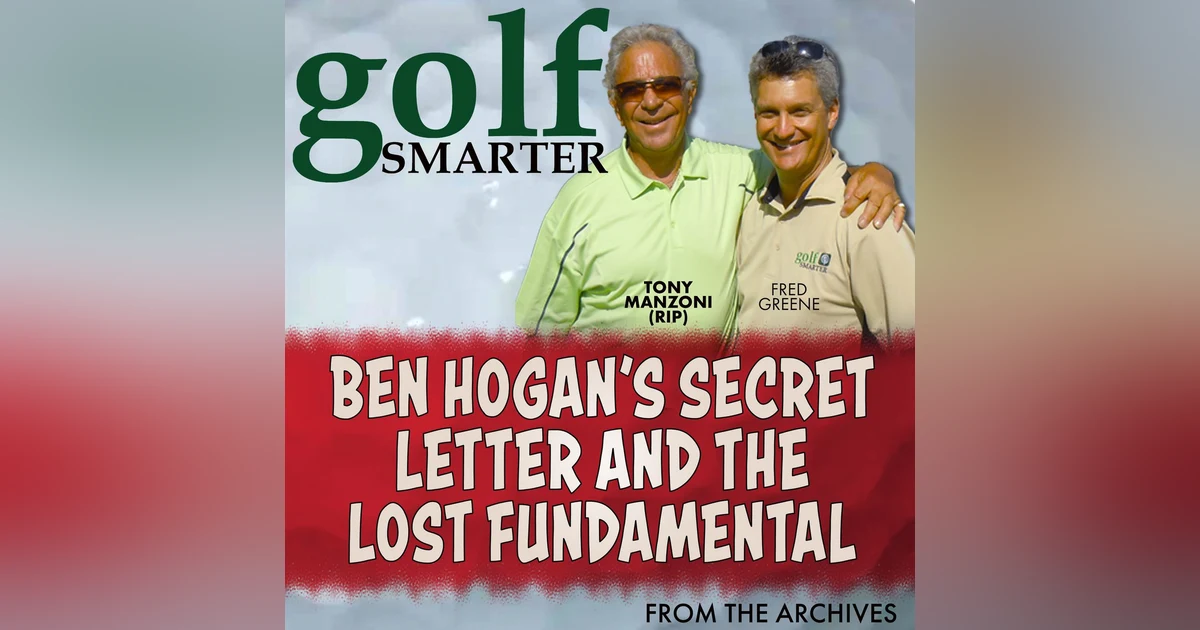
Ben Hogan's Secret Letter and The Lost Fundamental Short Game with Tony Manzoni (RIP)



 RSS Feed
GS#'s 438 & 439: May 28, 2014 Tony Manzoni, one of the most sought after coaches on the GolfSmarter podcast shares his life long pursuit of Ben Hogan’s secret to his golf swing. Years ago Tony received a letter written in Hogan’s hand that explains his secret to becoming a great ball striker. This is the complete hour-long conversation that also covers a detailed discussion on the short game swing and how it differs from the full swing that is discussed in The Lost Fundamental. He also responds to letters asking how the full Lost Fundamental swing is affected by the short game swing.Tony’s book "The Lost Fundamental: One Simple Move, Better Golf Forever", is available on Amazon in paperback or Kindle format. His video, originally a DVD, is only available through our website. This is combined two episodes in one as it was difficult to schedule podcasts in advance “in the old days”!
If you have a question about whether or not Fred is using any of the methods, equipment or apps we’ve discussed, or if you’d like to share a comment about what you’ve heard in this or any other episode, please write because Fred will get back to you. Either write to golfsmarterpodcast@gmail.com or click on the Hey Fred button, at golfsmarter.com
0:02 Hey, this is Fred Green of Golf Smarter with our seventh installment of spring Back into Golf season with the late Tony Manzoni. This episode was published in twenty fourteen and podcasting still really hadn't caught on yet, so there wasn't a lot of competition between distributors at the time or know how to work the system. I'm pretty sure that was before I could schedule an episode to publish while I was on vacation. Now I can make sure that you never miss a week without a new episode, even when I'm away. So this episode was two weeks with Tony in one show episodes four hundred and thirty eight and four hundred thirty nine. So we packed a lot of information and a lot of topics into one long show, and it's a long one. It's over an hour now. Tony's book The Lost Fundamental is available on Amazon, and his DVD, which we converted to a private link online, is also available when you write to me. And for the most comprehensive information ever collected about Tony Manzoni, please go to Golfsmarter dot com. If you'd like to access that video, please write to me directly. Golf Smarter Podcast at gmail dot com, or click on the Heyfred button when you visit golfsmarter dot com.
1:24 For members only. Golf Smarter numbers four hundred thirty eight and four hundred thirty nine. Published on May twenty seven, twenty fourteen. This is two weeks where the episode's delivered it once. It's an hour long conversation, but luckily it's a podcast and you can listen as much or as little as you want. Starting right now, Ben Hogan's Secret Letter and The Loss Fundamental Short Game with Tony Manzoni. This is Golf Smarter. Welcome back to the Golf Smarter Podcast. Tony, Hey, great to be back, Fred. It's great to talk to you. Have you been well. I had a little bit of a mishap. It's kind of funny in a way. I broke three bones of my right foot ankle by falling from a hill, hit a wet spot and slid downhill and body weight went forward and right leg didn't want to go forward and it snapped like a twig. So it's been a little setback, but other than that, life is really good. My golf team did well again. We won the twenty seventh Conference championship in a row, which is kind of crazy. Each year, I just shake my head. I don't know why it keeps happening, but it does.
2:38 Do you recruit these kids? Are they find you? I mean, you keep winning and winning. Yeah, we get them from all over. This year we had a bunch of boys out of the country and some of them, yeah, some were really good players. And they're all coming back next year. But I always say to them, how did you find the College of the Desert from Belgium? But they go on the website and if you look at the website, you know our record really is really is sensational. And then the area that we'll end is such a beautiful area for golf. We go over one hundred golf courses, great weather, it's spring when we compete. We have a wonderful drive range on the facility. I'm a PGA member. I like to hope that part of them coming is my coaching, and the whole package is good for young person that really wants to get into golf in a serious way.
3:36 So yeah, guess details, Yeah, more details about the school where it is and so people can Yeah. The name of the school is College of the Desert, it's in Palm Desert, California. It's a population of about ten thousand students. We have been rebuilding the college, built all kinds of new buildings and campus is fabulous. Of course, the weather in Palm desertgard to Cochello Valley is second to none, and especially in springtime. So it's just a marvelous place to come to. Uh. You know, we have a lot of we have the Coachella Fest and all kinds of activities for young people, but it's just a great place to live. I'm very lucky I left the Bay Area and you know, we we all know this is one of the greatest citas all all time, if not the greatest. Yeah, I do miss it, believe me.
4:28 But but for me and golf and what I had wanted to accomplish, this is probably the best place I could have come to. M Well, congratulations, you guys have just owned it. And uh, I think it's more of a testimony to to your teaching. But even I hope it's part of it. For sure. I have I do have a formula that I use every year and it seems to be working out. And you know, the kids nowadays, you don't really have to teach much. When it comes to the apple, the movement of the swing, they're all pretty up to date, you know, they're all into rotation and connection and so forth. So it's not a hard sell. It's not like it was, let's say, fifteen years ago, where everybody was, you know, more of a hands and arm swinger opposed to body swinger.
5:22 So that parts are really good. Well. And we've also had tremendous success. Your book and the video actually the only place that really available on golf Smarter. And it's amazing to me what a phenomenal response you've received from the golf Smarter community. It is amazing because you know, I'm you know, seriously, I'm a no name. I'm just a golf professional, although I think that i'm a pretty good teacher. And when we did the book, when we did the book, I did it kind of a friend and family and hoping that some people in golfing community would like it and accept it. And I must say that I'm pleasantly surprised.
6:11 Thanks to your sight too, you have such a great group of people that are on your site all the time, so that's been a big plus for me, and I enjoyed a small success, so people out of the country by it, which is always kind of cool. And all over the world. It's crazy. It's crazy. Well, let's talk about the book and what you cover and what your method is, because it's very effective. It is a quick history. About fifteen twenty years ago. I had NFL walk in my office and tell me, would you like a copy of a letter that Ben Hogan wrote by explaining how to hit the driver? And also he has a film that was private film that he had taken and known I had actually seen him be home and swing, and you know, I almost jumped on his lap. So I read. The first thing I did is I read the letter, and the first thing I noticed was that Hogan stated, but on the top of the back swing, he has his weight shifts shifts to the instep of his left foot. And when I read it, I thought, well, I think he means the instep of his right foot, because that's what all traditional think he was. And then I went on to read the letter and that was really informative, and a lot of stick figure pictures and so forth. And then I watched the film, you know, and it was very obvious that he was staying on his left side. Throughout the backswing,
7:42 it looked like he set up a little bit like side say sixty forty, and I think when you really center your head to the golf ball, you must be a little bit more on the left side of the right side. I noticed that his right the right hip was aligned on the inside of his right foot, so that was his right side. And I just noticed that when he's slung, he rotated his shoulders around his pine and the shoulders really were more level than his earlier swings. And the film that I had was after the accident, and that's really when he said, I'm going to start playing off the left side. And the funny thing about that statement the left side, A lot of people say that, but they don't know what it means. It certainly isn't stack and tilt. A lot of people will say, oh, you teach sack untilt, and I don't. And I'm not speaking against stack and tilt. I just believe that the shoulders really don't tilt on the down swing. I believe they turn based on the way they were set up at the ball, because when they tilt, it really steepens the swing and the down swing and it also the hands must finish, must higher, and the body ends up in kind of what we used to call a seat position.
9:02 And people that do that on a lot, you know, do that a lot end up with lower back problems, as did most of the people from the era that I played in. So I believe in turning more level, as Hogan says, to turn the level left and posting up so that when you when you finish, your body is really more erect and your weight is really on the left side, and you're not your body isn't tilted back. Uh. So when I got all this information, I started applying it to some of the people that I taught, elderly people who their first complaint was I want to hit it farther. That seemed to be the number one chant that I got from everyone that I said, Well, what would you like to do in the golfing? I want to hit it farther. So I started working with this, and Holy mackerel, uh. Because I had them more on the left side, I can get them onto the total left side. I get them through the golf ball much easier than when they transferred their weight right and then back to the left. And I readily saw that there was a rationale for doing this. This wasn't a band aid, but this was really the way he did. And then going back into filming, you know, I saw the Palmers and the Nicholas's and all the greats. They had long careers, their head was very steady. They had did not move to the right in the back sleet. So little by little I started really buying into this. Then I got a call from al Geiberger, who is a resident here, and of course I'm a very famous golfer, mister fifteen nine.
10:35 We call him and al said, you know, when I read your article in a golf magazine, local magazine, I thought you had flipped your wig, he said, but I started doing it with a fellow that was reversing his weight shift all the time. And he said it worked like a charm. I got him from falling back to the right side and he is now finishing and hitting the ball. You know, really really great. And then I started to tak creating. Now think about this, al Geiberger Lawyers having one of the great gosspems of all time. And he said, because of my age, I can't get to that left side like I used to. And he said it works like a charm. So that was the kind of the catalyst in the history of how I really bought into this, because I had to buy into it just like everybody else I was taught. You know, shift you away to the take your shirt them and shift your way to the right leg and then shift back to the left. And you know, there's a big timing element there because you've got to make a little lateral slide and then rotate. And this eliminates that lateral side slide. So then everyone that I taught, so you know, you need to write this in some kind of a book for him so other people can see it. And you know, they were rubbing my elbow pretty hard there.
11:53 I'm the elbow, I mean, my ego pretty hard there. So I thought, well, what the heck, why not do that? So I wrote that little bit arioto, small little book, as you know, but I think it's concise. And I have done this now since today I got that letter. I have been continuous. I have never stopped doing this. And I can tell you that I have never had anyone say I can't do it this way, I can't hit it this way. I think this is wrong. Not one and I would tell you even if there was one, I would tell you it's never happened. And I've had a lot of guests, by the way, come from your side your site, that came into town to take a lesson from me, and I must say that I got love letters from them after.
12:37 M I've received those letters as well. I've had people in the golf Smarter community right to me from all over the United States and even outside I'm pretty sure, who have come to Palm Desert in the Palm Springs area in southern California to take lessons with you and were just just so happy of the results. It really has been astounding, and you can only thank mister Hogan because he was really the one that I think there was other players that played off the left side for sure in this era, and subsequently some that did it after. I mean Lee Trevino, on a conversation I had with him, said to me, I've seen a lot of guys that had great, long careers that played off the left side, but I've never seen anyone that had a long career that played off the right side.
13:36 And I didn't understand what he was saying, and of course, like most people, I was embarrassed to say, what do you mean by that? But then after I got into this, I certainly understood what he was talking about, and no true statement can be made. The thing I love about it is that I get women that have started to play golf later in years and also men, and they've taken a couple of lessons they and I say, well, you know, you're really finishing your sway it. My protone is shift my weight, but I just can't do it. And I explained to that, I said, the reason you can't is because your body's in the wrong position. At the top of the E're in a place where there's no way, no place to go but the hit off of the right foot. Throw your arms at the ball and just hope that your hands square instead of roll over and closer, are stay open. And that's why a lot of people, you know, they slice the ball and then they pull a ball and now they don't know where to go. And it's just primarily because they've put the responsibility of scoring the clubt with the hands and arms, and that is tenulous at best. When you do this system, you set up to the ball and you create your triangle your arms and you set to the golf ball.
14:51 You rotate your right shoulder behind your neck, so there's no movement to the right. What you're doing is displacing your weight behind your spine, and in doing that, the right hip and right shoulder go behind you, and you actually add a little bit more weight to the left side. The right arm folds into its throat position simultaneously as a right shoulder turns, so it's a real simple move. You're not trying to take it back low or do all these things that we've been talked about are cockterist here. Don't talk to rists here. You just take that try and go back with the rotation of your right side behind you and let the right arm fold naturally, and that sets the club and it's in your throw position. Because everybody's in a little different position. If I give you a baseball, say throw thread, you might throw it from a little different position above your shoulder or below your shoulder than I would, and we're all subject to that.
15:40 So it's ludicrous to tell someone I don't say that you have to put the club here, because here it doesn't exist. It's depending on their anatomy. And then the next part of it is I don't get involved with where the club is at the top in the sense of is my wrist flat or is my wrist cup the natural hinging of the risk occurrent. Some people it flattens a little bit, some people it stays cupped. It really matters is word's impact. And I find that, you know, Halging cupped his wrists like crazy, but it impacts his risks were flat, And I think that's really not a part of manipulation of the hands. I think that's part of getting the left side out of the way, keeping the left arm connected across the chest. And let me say this, no matter who you are, if you're right handed golfer, when you take the club back, your left arm goes across your chest. So that's not some trickery.
16:36 That's the only way you can move. And when that left arm goes across the chest, it connects. It connects on top of the pectoral muscle of your left side of your chest. That's that's where true connection is. So when you take that club back, the right arm folds, that left arm is stretched across the chest. Where that chest, where that left arm is is setting, is where it must stay. On the first move of the That's why a lot of people used to put a headcover under their arm pit or a handkerchief, and that was to keep that left arm from coming down immediately in the downswing. Because once you do that, you are now subject to what your arms can do. You've left your body behind. So all this stuff about dropping the hands first, I mean, I'm not saying that you can't do that, but for the average person, they drop their hands first, they're going to just pull their arms down and they're going to either hit it behind the ball or hit it fin and if they're lucky, they're going to hit it in the air. But they're not going to hit it with any force because they're only using their arms. They have eliminated their core. Or when you take the club back correctly across the chest and then you wrote you start a rotational movement, or as you're doing the opposite of what you do on the backsley, you turned on a single axis, which is your left side, and then you rotate around that axis and that arm stays there. Eventually their right arm straight is the club hits the ball.
17:59 And then as you rotate to the left, and you must have a club follows you back to the left and the left un fold. It's just like the right armfold on the right side. So it's a really simple It's a simple, simple move. And I have people that come to me that are, you know, ones and two handicaps, thirty handicaps, and they always say, what do I have to worry about this? Don't I have to worry about it? I said, no, you're hitting the ball great, aren't you. Yeah, I says, golf is like every other sports. There's a domino effect. You you make the correct move here, a bunch of good moves happen, you get in the wrong position. I don't care who you are, you're going to have a tough time with the game. I get frequent questions from listeners asking me about the book and the DVD that you have offered and want to know your response. Which is better for them to I always say, just buy both. But when somebody wants to, when somebody wants to study more of the Lost Fundamental which the name of the book and the DVD which are both available, and our golfer smart goolf smarter dot com, tell me the difference from your perspective of what those two have to offer.
19:12 Well, I think that we all learn differently. Some people like to see it and some people can when they read it, they can see it. You know, I personally love the book because I can go back and I can put in the yellow marks where I well, I think it's important. I think because I forget myself. Believe me. You know, there's a science to this, and even in a simplicity, the sequence has to be correct. And when I hit a ball fan or fat, I know that I first of all didn't get past the ball. And that's one of the one of the things that I hear all the time. Stay behind the ball, Stay behind the ball. There's no sport that I know where you don't move through impact when you throw a punch, when you hit a tennis ball. You have baseball, there's a movement forward. Now it isn't a straight line movement, but there's a movement past the ball. For sure. You got to end up on your left side, so you're rotating around that axis. But pass the ball. You want your right shoulder and right hip to go past the golf ball.
20:16 You don't want to keep it behind. And that's again what I see on the drive range all the time. You see people end up with their swinging still back on the right right foot. And there's a couple of guys on tour that I won't mention that if they understood this and got over a little bit and address on the left side, they wouldn't be hitting off that right side and all of a sudden hit it a fairway left or fairly right, which they still continue to do. And these are unbelievable golfers that have so much talent and do it every day. Think about the average guy, our gal. They don't put that much time and they don't have the physical attributes that these people have, so how the heck are they to go play the game. And that's why the score has primarily stayed the same for men and women. With all this technology, new ball, all this stuff, his course is still really, really high.
21:06 I've always had a wrist hinge issue with my left hand. I'm right handed, but my wrist is hinged. I'm just starting to get it under control here, but I've always found that what the impact it had on me was that my club face would be open at impact. And so the. Ball most people roll, yeah, most people roll, or it comes with the right hand grab. They roll the club open. Okay. Now that's a compensation that has to be dealt with on the dolls wing. So you got to roll the club closed. And who can roll it open and close it and get it right back to where they started as they're moving. It's seventy eighty miles an hour with a club club that speak. I mean, it's just it's all silly to think you can. So most people that roll it open and then close it hook the ball.
22:00 In fact, that that's how a lot of people when they want to look the ball of fan it and then close it and they'll get a little drawer or close it coick to make it go on corner. The correct way I believe is that when you when you hold the close in your hands, your right your left wrist should be bent and your right wrist should be flat. Okay, And what you want to do is you want to move that position at least past your right leg in the backswing, and you move it with the turning of your shoulders which swings the arms back. Now, if you do that, if you do that, if you can get past that and just let the natural occurrence happen. What will happen is that the right wrist will go back a little bit and fold down like you're holding plates.
22:44 Depind on how much how much flexibility you have on there is, and the left wrist will flatten a bit. It may it may only hinge like you're hinging a club towards your nose up and down. May hinge, or it may flatten a little bit. And then again it depends on the way you have your hands on the club, flexibility of versts and so forth. Remember the backswing, it's just it's just the point where you're changing directions. So it's not you take the club up to a spot and stop and start. That's just you know. It also is a continuous move. But to start the club back, you need to start back slow. It has to have a rhythm, but it has to be slow because if you start fast, two things occur. You're going to grab it with the right hand and you're going to pull it right wrist back. You're going to bring that club back to the inside too soon. That's number one and number two. When you have a fast back swing, you're always going to have a short backswing. Those two go together.
23:44 So if you want to hit it a long ways, you have to have a why swing, and you have to have take time. As I tell people, if you're going to shoot an arrow with a bowl, you got to pull that bowl all the way back. There's a time period to do that. So you see people with these real short, fast swings. They hit it nowhere. And that's the majority of people are playing because they're not sure what they want to do, so they get quick, they get it over with. How would you advise someone to change their tempo and be conscious of it. I have a friend that I've been playing with. I've have a friend that I've been playing with for years that stands over the ball for almost forty seconds. He just stares at the ball and then all of a sudden, if you blinked, you miss the entire swing. It is so fast, and he can't understand why he doesn't get better, and it's like, dude, slow down.
24:41 Well, yeah, first of all, he needs to he needs to have a pre shot routine. Whe starts from behind the ball and then he goes to the golf but looks at the target, looks back at the ball, and as he's doing that, he's aligning himself and calming himself down. And then to start the temple. A good A good way to start the temples. Start with like your right knee kind of a kick in. It just kicks kind of in like a forward press. But you really want your body to set the temple. You don't want your hands and arms to set the temple because they'll get out of position immediately. These they'll get they'll get across you, and your chest has moved. And now when your chest turns and your shoulders turned, your club's going to go way inside. So the sequence has to be a more one piece. Now, you know, I don't mind if the club hit moves a little early, a little first, but I like to feel as if I set the temple with the sternal of my chest. Some people like to set the temple with their shoulders, but for God's sakes, you can't set the temple with your hands because you'll start slow and then you'll quick you'll you know, yank it back because you'll it just doesn't feel right. You've got to do this like you're winding up your body and not just taking your arms back. And that's the I think that's a good thought. Is that a slow wind of the body so that you can really get coiled, and now you've got some room to create momentum on the down slid.
26:07 How do you create the tempo or set the tempo from your sternum? Well, I think about I think about my chest turning. Okay, So I just think the center of my chest. So I connect my arms and so my arm. Imagine that my chest is a picture and my two arms are a frame of that picture. I try to keep that picture the chest between those two arms, okay, And so I focus on that picture, and I'm using this analogy because it's my picture. You know, other people might use their nose. I don't know, but I use that, and so I try to keep that picture inside that frame as I turn. So in doing so, I'm taking the address position and I'm moving it to the right of me.
26:55 And then of course they're the right arm poles and puts club in my throat position. But that's my process because I've always been fast. I've been a Lanny Watkins kind of backswing. And you know, if you have the challenge at landing Watkins, you can get away with it. But I certainly don't, and most people don't. So what happens, serily, you pull that baby aside too much. You mentioned about putting the club head cover under your arm made me think about I don't know if he's a disciple of yours, but I know he's a fan of yours. And that's Martin Chuck of Tour Striker out of Arizona. He's been on the show multiple times and he developed the Tour Striker Club and now he has a new product that this little inflatable ball that you can either deflate it and put under your arms, or when you inflate it, you hold it between your arms so that they stay connected, right, And he talks about he's been on the show multiple times, and he talks about you and your methods.
28:00 Well, you know, Martin, it's really funny. I was a member of I was giving an honorary membership at a club that Martin was an end proat here in the desert, and you know, I always try to stay away out of the way of the pro shop and all that, because I found a little guilty. I was paying any duds, I was paying any membership fees. So I was always the back of the arrangement I played. And this happened late in my life. You know, I saw I wasn't a great player or anything. Martin and I liked Martin very much, really a gentleman, a really nice young guy. But at that time we didn't really get social because I always, like I said, I always felt like, I hope he doesn't think I'm going to be trying to give lessons out here, or I'm after his job or anything like that, because a want of pros feel that way.
28:40 Martin has. It turned out didn't have that kind of thought in his mind. But one day he asked her if I would play in a junior senior event with him, and I said sure, but part of me said, oh, man, I don't want to shoot eighty because, like I say, this is end of my golf career. So we com paired with two of the best player in Southern California. One guy's going on the tour, one guy just got off the senior tour. That was there's team against us. We started the first one, we tied them, but they had blasted their balls out there fifty yards past both of us, and then we had started. It was a shot to the event. We started on the ninth hole and then it was like a crazy thing. I made a birdie and ten and eleven, Part twelve, Birdy thirteen, Part fourteen had a whole in one in fifteen Birdy sixteen. Yeah, and I shot like twenty nine or twenty eight on the back. Then, Oh, I said, what are you doing out here? Martin? Somebody should put up a plaque right now because a miracles occurring. Well, anyway, long story short, I think I shot one under on the back and Martin shot two or three under on the on the other side, I should say, and we win the tournament going.
30:00 I mean, it was just it wasn't even a contest. The two guys were playing with the looks on their faces. Was at wish I had that picture because of this classic as they figured, you know, especially on the first roll of the droll it out there about three ten each and we're out there about two sixty. You know, well, we're going to get rid of these guys real quick. Is to turn off. We love the tournaments, so, you know, Martin and I we've laughed about that that tournament and the only time we ever played together. Okay, and we've never really talked about the golf swing, but I watch revolutionary golf every now and then, and Martin's on there, yeah, and are on your site, and we talked the same language.
30:42 We believe it the same thing. And as ironic as this is is I had to see Martin for years. I went to Lake Tahoe last summer with my gal and one of my clients golong to a golf course up there, and when I walk in Gus Jones, who I know very well from the desert as an anttro and Martin Jeff is a teaching prone I just about fell over. So we had a big laugh over there. But he's a great guy, really, a very very fine golfer. I mean, and you know, if you want to watch one of the golf singers, look at what he's doing and that tour striker and that he created his genius. It really is do. You like that? Do you like that product? And what it how it teaches you to come down on the ball.
31:27 Well, I'm sure I like him. And the only thing is I will say that it's for the average guy. It's very hard because the average guy doesn't do it right, doesn't get you know, it doesn't He's got that handle behind the club, he had the impact, so the head's coming up, so he stopped and he get the bowl airborne, and I must say, the first time I did it, I just shot it down the about a foot off the ground about what you know. But then al Geiberger was the first one that had had one, and he brought it over and he says, you got to try this, and then then after you know, my correct wink, can I start getting the ball here? And I thought, God, this is terrific, and you know it must be a good product trillion.
32:07 Yeah, he's having fun with that. I'm curious to go back to this, this tournament that the two of you played together, because recently in a conversation UH with Mark Brody about Every Shot Counts his book, and we were talking about golf metrics and how he's saying that statistics show that the drive for show put for doe is actually backwards. That you really if you hit the ball longer and farther, you're gonna have lower scores. I should say longer and straighter, you're gonna have lower scores because you're you're coming into the green with shorter irons, which are gonna, you know, increase your chances of hitting the green.
32:55 What was the key? What is it about you guys not hitting the ball far, but okay, you got a hold one. But what is it that that beat them? And what can we learn from that? What really happened? Uh? I kind of after the really after the first tea shot, which was a it was mediocre at best, I kind of felt something. Uh it was like a little precock position and address. And I don't know how things happened. And I started because I was playing from the senior teas. I started keeping it up with this fellow and on occasion even doctor Passon and and I think I rattled them a little bit because you know, on the first first tee shot he got me by at least with few arms, So that was part of it. And then my iron plate just got stupid good. I was just drilling it in there, and I mean I was laughing, truthfully, laughing to myself, like when is this bubble gonna bursts? And just to think about this, going holding one birdie Okay, yeah, I mean usually you go hold one triple bogie excited, but it just, you know, I guess I kind of got out of my own way and it was an overdrive when I got that feeling that no matter what I did.
34:20 It was going to be good. And you know that they call that the zone. But you know, you know, I have a fifteen or twenty foot put bam in the whole ten foot plug bam, and the whole five foot plug baman. It just it just just they just went crazy. And then when I got a little bit conscious of it, you know, and you shoot under thirty uh, and then went to the other side. I had started with a power. I had eight holes to go. I had a tough time because I was conscious. I wanted to shoot some you know, your ego gets so going out of proportion. Uh. So you know, like I said, I think I was one under or something like that. But that one night was magic. It was just I thought, this is what it must feel like. Could be Tied Woods or whoever you because you know, it was just simple.
35:10 It was just absolutely simple. Getting back to what you said about something, I'd like to bring something up from my past years ago. I was training some ladies on the LPGA when I was at Mission Hills, and I mean because they had the craft of the Bisco at that time, and I became a big fan of ladies golf because I saw how great they hit the golf ball, but they couldn't hit it very far compared to a man. And I started thinking about it way way back when they had a tournament. I can't even remember that there was a man and a woman against a man and a woman. So just for the fun of it, I started using the computer and looking at the distance. And women hit the drive and also the second shot. And when I looked at what the ladies tour was, hardly anybody.
36:00 I was reaching power five two and they were hitting long irons and sometimes ferry was to the par fours where the men were hitting drives eight iron, seven irons right in there all the time, and the long hitters were brought away with the power four as you drive and ledge. So I compiled a distance advantage that I thought men women should have over men, and I wanted to set up men tournament, I mean a livemen against men tournament. And we came up with seventy five yard distance. And I knew Sandra Palm and some of the gals from the Dabisco. They had told him about it, and we went over to a golf course and at that time I could pop it out there three hundred yards plus, so I played from the back tees and then I moved the girls up seventy five yards and we hit our t shots. Said well, heck, they were still ahead of me even if I busted it, because they needed to be because they needed to hit cbs going to hit an eight R and I hit an eight air and at that time about one sixty five seventy they would have to be They would have to be able to hit hey from their distance probably about like one fifty here one forty five, so they needed that distance advantage also the second shot. So it worked out great, and we played nine holes and they shot. They were all, you know, five under, and they, you know, very excited, thirty one thirty twos for you know about thirty six.
37:22 So I got some people interested in my concept and they said, well, we'll fund that. It's culinary work. Reginie and I went to the PGA with the idea. I'm trying. I can't think of the name of the guy. Then there's a good player. He was an attorney with glasses, and he immediately said, no, we would never do that because you know, we have nothing in the game. So I came back with my tail between my legs and I met with Commissioner Revolpi, who was a commissioner for the LPGA at the time, and we talked about it and said, well, there is one chance we could do the thing in December when there is no tour. We could do it like an old tourk dance. We'll have the gals invite the guys. So my friends that were sponsoring the thing in the Hotel Workers Union, they got the Dual Country Club and we had the gals invite boys.
38:17 Sider Palmer invited Arnold Palmer, and anyway, we had Trevino Palmer, we had everybody, and we did this tournament and it was there also success didn't have it on regular television, had on PBS, but you know, everybody really enjoyed the event. But they didn't play men against women, but they did give the gals a seventy five yard dis stands. The second year, Frank Sinnotra, who I knew very well. So I'd like to sponsor that tournament and I'll bring a Stayers Roebuck in. But she did, and you know, long story short, just before the tournament was going to be announced, the stress Annountras mom Lew was in a jet plane just go see him in Vegas and they flew right into the Santa Rose and mountains here in the desert.
39:04 She died and he had to back out of the tournament, and of course Sears went with him. So there I am now, and I spent more money than I had trying to promote this thing and make the appearance of success. You know, fancy card closed. So because I was meeting with the Actors Equity, which was one of misters charities and for actors that are now on their luck, they either pay for their medical bills or so far. Well, when I got the word from mister stops people that you know, he couldn't announce obviously, you know, with mom died, calling LPGA got the tournament with the PGA and they had waiting in the Wayne's hands, uh J C. Penny's and that's why of them became a JAC Kenny's Mixed Team Championship and out of I think they played somewhere in Florida Hampound or something like that, and it was on TV for about fourteen years and everybody said, well, you got to sue, that was your idea and you have all the paperwork, and I said, look, I was trying to promote ladies going. I don't give a damn about suing anybody I feel like I got. I should have been giving a pad on the back or a goal watch or something. But the key thing that the key thing that I was bringing this up about it is not so much I lost the term and everything, but the disparity between men and women's golf is distance.
40:31 It's not ability. Believe me when I tell you the gals can hit the hell out of the golf battle and they can. I think there's a few gals out there that I'll put against the men and putting any day. But you can't overcome the distance. And you know, when Michelle Wee was coming out when she's fourteen and doing so well, when people were saying she's going to go on the tour, they interviewed me and I said, look, you know, I can go lift weights for ten years and then you put me in a cage where a bear or a lion or or whatever, and they're gonna tear me apart. And that's that's nature and yellow. The show's a wonderful little gallagy. It's all really good at going.
41:14 She can't compete with a man. We don't don't, don't be stupid. That's all that, all that garbage, and I think the people that were pushing that hurt her. They put a lot of pressure in the girl and I so I have to see her playing great golf again. But there's a there's a distance difference. And when you say is there an advantage and love, sure there is, of course there is. If I've got an eight iron into the green, you've got foreign and the breed, we're somewhat the same. I'm gonna beat your brains up. It's just because well it's just it's just science. I mean, it's just math. It's an easier shot. So you're absolutely right when you say that does mean something. But distances it everything. And that was proved the year when we were in the regional championship. I had a boy that could need a three forty or fatigue with no doubt.
42:08 But we played a real tight little golf course where you can't hit driver. They just look the designer and just love you to hit drivers that you could not head out of bounds. And that's exactly what happened to me. I don't want only three drivers out of bounds. So that's craziness. There is a point where you have to look at what the what the hole is and then you have to say, Okay, this is what I must do. I'm going to take double and triple and all that out of play. By doing this, that's managing yourself on the golf course. That's what I try to teach by players. Sometimes they listens and sometimes they don't. The distance is an advantage to a point.
42:51 So now on the women's tour, we have an eleven year old who's making headlines. Yeah, isn't that crazy? What's wonderful? Action, It's really wonderful. Tell me what you know about her and what you've seen and what your thoughts are about someone who can compete at that level at that age. Well, you know, I saw that she had one of the pitch and put things, or was one of the winners at Augusta, and it turns herround and gets on the tour august in a, qualified for the US opening, makes it for the ladies. It doesn't surprise me. Fair. I've got a fifteen year old by the mayor, June Jang that found my video. I started her when she was a little past twelve, and recently she played in a major event in it was called a silver Bell event, I think in Phoenix somewhere, and she shot seventy four, sixty four, seventy against twenty six year olds. And just recently she played in the Golf Week magazine tournament. The previous year's years shot sixty seven seventy one to win it, and this year shot seventy five with a triple part five which she tried to go into when there's water on both sides, and she learned a good lesson. But then she came back with sixty eight and she said, coach, I had ery green, and she said, I missed so many puts. I could add fifty nine today. And it wouldn't shock me if she said, Coach, I shot fifty nine a day. That's how good these kids are nowadays.
44:22 What they're doing is what it used to take us ten years. They're compressing that into a year because they're practicing every single day. They got a wedge or a putter in their hand all the time. They're not thinking about they're not thinking about music, par dos, nothing. All they're thinking about is how to get that ball in the hole. There's a mindset out there with a lot of young kids that just love the sport. But it's like what happened when the Beatles came out. Every mom and dad wanted to give their kid to get the guitar to learn it because they saw a chance for fame. And I think that's what's happening. Young people are starting to really discover golf. And you know, you're like a rock star. For God's sakes, if you're really good in golf, Here here a star. You know we see in the men's store. Well, the same thing is going to happen to women's. But the women's will never be as popular as men's because that's just how life is. But but if you want to see quality golf, watch of women play.
45:24 It's it's it's unbelievable. Uh. And and they're and they're and they're a getting longer. And when you read these stories about eleven year olds making it's just great for golf, and women's golf especially, but more importantly it's great for juniors. For a kid they see my god, and eleven year old make it, Mom, get me a wedge by me said clubs. Uh, you know, we know that it takes a lot of hard work, and you have to be a special training of person to get it all the way to the tour. But it's still this is such a great sport. It's such a great sport for a kid. It's a lifelong sport. Teaches us so many great lessons. And hey, every now and then, out of a batch of kids, you get one that's so special. And June is to me. I mean, she's like, she's like my daughter.
46:09 I mean, I just adore her and she is such a hard worker. Uh. I had a couple of big universities called I can't I don't want to mention their names, but they're already looking at her, and she's a sophomore fantastic. So it didn't surprise me. I mean it did a little bit, but I didn't say, oh my god, that's not impossible, because it is possible when you when you go to some of these a j g as, the events and some of the things that the PGA does and those those they should be so thank for doing that, and you see the talent that's out there, it's just it's mine. It's mine, Bob. I've got a seven year old and I'm teaching right now, and I want to tell you something he got he's got corrected also, and is anybody on tour? I mean it's when I say it's perfect, it's perfect. And he beats the ball out there way farther than a seven year old. Shit it And where's he what's he going to be doing when he's fifteen and sixteen if he continues this and all he can think about it he watches the golf channel.
47:09 He doesn't watch SpongeBob. It's crazy, you know, it's crazy, and I love it. I mean, I just love it. So the fifteen year old, if I'm not mistaken, is it June Jang. Jane Jang, And she's on my video and the swing that he had is tighter and better than it was then. It was pretty down good bed. Because you, yeah, at the end of twenty thirteen, you sent me a couple of video clips of her swing and I will definitely put those up on the blog post with this show. But you also sent me the video of the seven year old boy what's his name?
47:49 Ivan Tran, Ivan Tran, Okay, I'll put I'll put those up so people can see what you're talking about, because yeah, I interesting, there's short there's short videos. They're real quick. It's just the you know, kid swing, but you'll have. To do you just look at the swing. You say, Holy Macro, how the heck did he do that? And in Iran's case, I can't take credit for the swing because he watched the golf channel and copied it. And so when his dad came to me and said, would you help my son? And I han't seen him at the ball in the range because every time he comes out there he draws a crowd. I said, well, I said, you've done a great job with him. He said, he won't listen to me anymore. I crashed up seventy years old ago. But the truth is the dad doesn't play golf and the kid knows that. So I had such I mean, I want to tell you something. I would pay to give this kid lessons. And I don't charge I don't charge kids, but I would pay to give this little kid lessons because it's just looking at a phenomenon in the future. I mean, this kid's going to do something in golf, is going to be crazy. And he puts his chips like a pro. I mean, already he gets on the putting green and you'll see all people punting everybody stops because they see him roll one after twenty foot or one right after another bag, And I just sit there and just watch the ball just keeps going in the hall. He thinks it was supposed to happen. Yeah, it's fabulous, It is fabulous.
49:18 Well, so, I've always been fascinated by young people who come up on the tour because it's golf is well beyond physical skills, there's the metal aspect. There's the emotional aspect of dealing with the pressure of a Sunday round. And you know, I'm thinking a seven year old, he's going to bang it away. He doesn't even know or understand what it means to have the pressure on, you know, with all the eyes watching and got to make this putt. How is the metal side for? I mean, these kids can hit balls like crazy all day long. But put him on a golf course in competition. What happens then?
49:59 Oh, I haven't played in a number of tournaments which he's won or been in second place. Yeah, competing against seven year olds. Right of course, yeah, of course, yeah. But but but this is the thing that I think that is happening like this eleven years old eleven year old they see they can do it, they enjoy doing it, and they love people watching them do it, So they don't have the insecurities and the feelings why can't I beat this? They don't. They don't even think that way. It's a totally different way of thinking. And I think it's just the era we're in. You know, kids are kids are our other shell really early because of television and whatever.
50:42 I think, think back when you were a kid, things you did and what's what's happening today? Because of because of I don't think it's all good, don't get me wrong, but because of Facebook and everything, everyone is more involved in the social aspects. So people will have a tendency to be a little bit more. They're not so self conscious. And you know, I was such a wallflower. I mean I remember going to a dance when I was a sophomore and I was I was literally stuck against the wall, afraid to ask anybody to dance. That doesn't occur anymore. I mean, that doesn't occur anymore because of the exposure that they have to everything. So kids don't have that fear that I think that we had because that's just how it was.
51:33 Well, they're in front of cameras a whole lot more than we ever were. I mean, there's no pictures of me growing up. But every young person I know, and I'm talking under ten, is so comfortable in front of a camera because there's been pictures being taken every few minutes. Yeah, and this is you know, this period of time now is where people are showing off a lot, shot off the way they look, where they dress. It was conscious of all these thinks. So I'm mean, I'm not saying that there aren't a few kids that still walk around hung up on this and hung up on that, but the majority are much more confident, I know that than when I was a kid. Of course, I went to parochial school and it was pretty it was pretty strict. Uh.
52:17 But these kids nowadays, I mean, the boys had come in my programs. I mean, they're already they've had experiences in their life that I didn't have until I was in my thirties. You know, uh, some good, some bad. But they've just been exposed to a hell of a lot more than I was, and so consequently they think more adult. They just they just they had they have more adult feelings in the sense of what they think about themselves, and I can tell you I've been If I tell Ivan, hey, come on, how want you need to drive for my boys golf team, he can't wait to show them that he gets it better than them. I mean he can't wait.
53:00 Me about your methods the swing for your short game, for pitching and chipping and not full swing, how is that impacted by what your method is? Well, you know, the chippion method has always been that you playoff if you're right handed, you put the majority of your weight on your left side. So that falls right back into what we're doing. And modern day chippers are less handsy, the more arm shoulder weight left and a small rotation uh just and the rotation gets bigger for the for the longer the shot. But but there is a rotation, so they keep the arms connected and it's still a body movement a post to just the arms.
53:51 Not to say that you can't do it with just the arms, but again, when you're use it arms and hands, you're bringing in the opper coortunity for the hands to overwork or for you to decelerate your arms where you stay connected and you turn through it. The club is moving along with the body, so there's no hit to the ball kind of thing. You have to be on the left side for sure, because you want the club to be coming down when it strikes the golf ball. So that's part of it. It's not it's not difficult, for sure. It's not difficult. So well, I think shipping ahead. I'm sorry, I was just going to say. And then of course I teach the fall running type of chipstroke.
54:37 So shipping where you're all on the fringe and shortside of the grass. You know you're going to do that with seven and eight six irons, you know, can you be using a sandwich and those guys shots pitching when you're further back and heavier grass where the club has to come up down but you're still on the left side. It's just that's just more of a you know, that's just more of what I say about it swing though. The real chipping where you set up to the ball and you you take the heel of the of the club off the ground, so you put it up on a toe. And the reason you do that because you want to get the shaft in the same position as your putter shaft, so you get your eyes right down over the ball. That you're just using an arm armed you know, arm swing with a fly left wrist, very similar to your puddy's stroke, and that should be done around the green. You know, put put away your wedges around the green. You want to you want to hit the ball in a release and roll to the hole.
55:32 You don't want to try to put back spin and all that. It's just silliness. But when you're pitching the ball from a distance, you know, thirty yards forty yards, then you have to do use a miniature rotary motion just like you do with the with the full swing. Real simple, Oh yeah, sure, real simple. No, it really is. When if for those for those of you that have chipping problems or anything like that, they ever come in the desert bell get rid of them in five balls. I mean, I promise you, and I don't care if you if you scoop it right at the bottom or anything. I have I teach you some pe classes beginners, and and I get a lot of these people have never touched the golfld in their life, and in a very short period of time, everybody's got that handle ahead of a ball at impact and it looks, it looks great, but it's not hard. To do. But if it's hard to do, if you're trying to keep your wrists flat and your body still and your head still and you're pushing your arms at then it's really hard.
56:30 Then you scull them across the green all day long. But that's not the action. It's it's you have to set up properly and you have to understand what what the movement is. But then once you get the movement, it's really simple. Oh boy, do I want to see that. I'm bringing the video camera for that one. Okay, anytime, this is a really duck soup. This is this is this is a simple part of the game. The only thing is a distance control. That's a hard part of that. Shipping and putting is yeah, yeah, it's what twenty foot You got to be able to hit it twenty one feet twenty two feet? Yeah, But most of the time I see the mistakes that happen for for chipping, is that people hit three or four inches behind the ball, and then well you get.
57:15 Yeah, that's because they're staying behind the ball. They're not moving through the ball number one, or they're trying to they're trying to scoop under the wall, try to get under the ball and make it go up. You hear people say they'll scull this, so I didn't get under that one. Well that you don't get under it. You're hitting. You're hitting. You have to get down on it. And the ball hits the face of the club. It slides up the face and then goes up in the air. But you don't scoop the club underneath, only shut it. I know that you go underneath like that as a sandshot when you when you lay the club back. But people try to do that. They feel like they have to help it up. And so in scooping, what what what to scoop? You have to You have to uncock your wrist. Your left wrist gets really cocked and the blade goes up so that that's that's the bana, you know.
57:59 But it's easy we fix once people. You don't say, don't scoop your wrists. You just show them. Do you show them a movement where they don't the risk, don't scoop. You explain how the thing really works, and then then it's really easy. The problem is is that a lot of teachers that teach say don't do this, Well, no, you see, you scoop it or you did this, and and so they're still fixated on that movement instead of getting them to do the movement that that eliminates that. But really, honestly, if anybody wants to shift, they can go on any on any website. There's so many guys out there that that are saying exactly what I say, because it's not a secret. And and and you know, keep in mind, the tour is constantly looking for easy, the easiest way to do these things, not the hardest.
58:49 So if you copy Mikelsen or those kinds of people, you'll see that they have a process that they repeat over and over again. But why that's that's where you're more strokes are lost. I think inside the thirty yard area, then. There's no question about it. Had no question about it. U I. One of the parts of my formula for the golf team is that you've got you got, You've got to be able to get it up and down from fifty yards and end. You just got to be able to do that if you want to if you're serious about being competitive golfer, you have to be able to do that. And it sounds really hard, but it's really not because once you have e motion that is consistent, and then you just can dial in the rotation of your body. But the distance when you do it with your hands. Now you know your nerve endings are at the end of the fingers, and we all get nervous, we all get anxious, and that never goes away, and hopefully never will because that's a good thing. Adrenaline is a good thing if you use it properly. But if you set up to the ball properly, whether you're hitting the ball, chipping the ball, whatever, and now your body dictates the distance the ball is going to go by, it's it's rotation and that temple, well you can you can fine tune this thing really quick, opposed to trying to time your hands how when they turn over, how fast they turn over, and so forth. And those are the things that that the modern swing, even though this is not really a modern swing, but it's it's a
1:00:21 modern way of teaching. You watch the tour now, you look at the guys when we start the ball, you don't you don't see anybody way behind the ball in the dress anymore. You know. There was a guy but the named Jerry Hogan and said, I want you to stand above the ball but not behind it. And that's a great statement. And that's what the driver or anything else. Hm hmm. Interesting, You're gonna have to come down and bring your wedge, a suitcase, a tooth brush, and a wedge. A long weekend. Okay, the suitcase, a toothbrush, and a wedge. Well, yeah, maybe, and maybe they e there so that I can show you the run up huts.
1:01:03 I'll bring the potter and we'll just play the entire round with three clubs. How's that? Yeah, there you go. Absolutely, that'll be interesting. It'd probably scored the same. Probably probably. Oh, Tony, Well listen. I hope you have a full recovery. I'm so sorry about your accident. And I know that I haven't asked in a while. How old are you now? I'm seventy seven? Oh my god, but I well, right now when I had the accident, I fell ninety seven. Yeah, I bet because you're all of a sudden saying oh I'm falling because I'm old. But what happened to me was if if I was fifteen, I would have got the same result. Unfortunately, because I actually the golf course.
1:01:48 I wonder what will happen if another member gets down there where I was, then try to walk up that hill and slips. The result is going to be very similar because it was just very It shouldn't be that steep anywhere near the green. But that's another story. I know a lot of people know how you get to sue, and I'm not a suing type, you know. Just I think God had that plan for me to teach me patience because I get a little impatient. My girlfriend is looking at me and nodding her head, so anyway, you know, I have to look at it as it gave me some time to stop working seven days a week, and I caught up on every TV show that exists, for sure.
1:02:30 But that's not something that's not something you want to brag about. No, it's just behind me now. And like I say, once I get to therapy, I'll be I'll be kicking and running again just like I always do. Just like you always do, and dragging that team with you across the finish line ahead of everybody else. Hopefully we can keep that up, baby. Yeah, amazing, All right, Tony, Well, it was great to talk to you again. Thank you so much for giving us your time. The golf Smarter community. He loves you, will always love you. And again, the book and the DVD, The Loss Fundamental by Tony Manzoni, is right here on our website. And I you know, I like to say this, and it's it's hard, but you're not going to find it anywhere else. Really, you could look everywhere on the web.
1:03:17 You're only going to find it here and so and that's why you're getting such a you know, the response from people all over the world. So well, I just want to thank everyone listening and leave them this thought and please continue supporting Fred. You are the voice of golf as far as I'm concerned, and I think you're doing a wonderful, wonderful thing for a lot of people.